
takesix
io.github.vvapnik/takesix
Lets an AI agent answer with a diagram you can click into, at most six blocks per screen.
Documentation
takesix-agent
TakeSix is an open format and libraries that let an AI agent answer with a diagram you can click into instead of a wall of text: at most six blocks per screen, and any block opens into up to six more. takesix.vapnik.de · FAQ
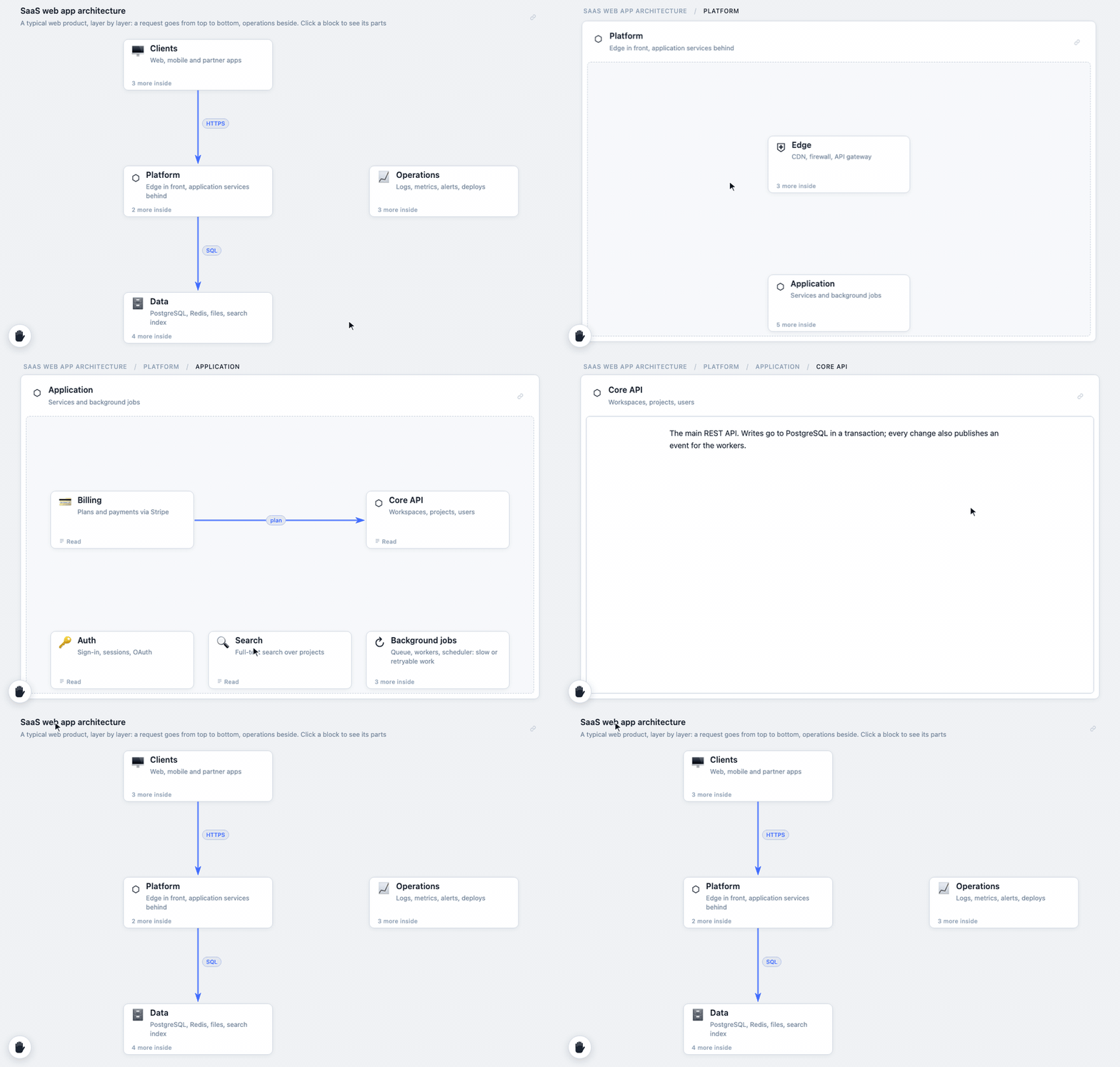
Lets AI agents answer with a takesix diagram instead of a long wall of text: the gist on one screen, at most six blocks, and the depth one click away.
This repository holds:
skill/takesix/— an Agent Skill for Claude. It teaches the agent how to design a readable takesix document, then checks and renders it with the bundled script. Nothing to install besides Node.js 18+.@takesix/mcp— an MCP server with the same rules and checks, for any MCP client. In apps that support MCP Apps the diagram opens right in the conversation.src/— the sources of the bundled script, the viewer and the server.
Examples
Live on the site, each with its .takesix.json and the prompt that gets one
like it from an agent:
| Example | What it shows |
|---|---|
| Architecture | A SaaS web app layer by layer, from the clients down to the data |
| Data model | A shop database: the tables and their relations, the columns inside |
| Presentation | A team talk: the parts in order, slides and speaker notes inside |
| To-do list | A website launch in stages, a status on every task |
Claude Code plugin
The skill and the MCP server in one step:
/plugin install takesix --marketplace vvapnik/takesix-agent
On Claude Code before 2.1.275, add the marketplace first:
/plugin marketplace add vvapnik/takesix-agent, then /plugin install takesix@takesix.
The manifests are in .claude-plugin/.
MCP server
claude mcp add takesix -- npx -y @takesix/mcp
For Claude Desktop and other clients, add to their MCP configuration:
{ "mcpServers": { "takesix": { "command": "npx", "args": ["-y", "@takesix/mcp"] } } }
What it offers:
guidetool: the format and the rules that make a diagram readable (the text of the skill). The server's instructions tell the agent to read it first. With atype(basic,architecture,plan,flowchart) it returns the blueprint for that kind of diagram;epicreturns an example that combines them.validatetool: checks a document (as JSON or a.takesix.jsonpath), lists problems with their JSON paths, or sums up the diagram's shape. A valid document can still get layout hints: arrows with a block in their way, arrows that cross.showtool: validates, writes one self-contained HTML file and returns its path. Where MCP Apps are supported, the diagram opens in the conversation, with a full screen button.diagramprompt: "explain X as a TakeSix diagram", with the guide attached.- Resources:
takesix://format(specification),takesix://schema(JSON Schema).
Where the diagram shows up:
| Client | In the conversation | HTML file |
|---|---|---|
| Claude Desktop | yes (MCP App) | yes |
| Claude Code | no, text result only | yes |
| claude.ai in the browser | needs a remote server (not yet) | — |
The server runs locally over stdio: no hosting, nothing leaves the machine.
For the official MCP Registry the
server is described as io.github.vvapnik/takesix (server.json, mcpName in
package.json). publish.yml publishes it there on stable releases from 1.0.0
on.
Install the skill
Copy (or symlink) skill/takesix into your skills folder, for example for
Claude Code:
cp -R skill/takesix ~/.claude/skills/takesix
Then ask for an overview of something structured — a codebase, a spec, a plan — or ask for a takesix diagram directly.
What the skill runs
node skill/takesix/scripts/takesix.mjs validate answer.takesix.json
node skill/takesix/scripts/takesix.mjs sketch answer.takesix.json
node skill/takesix/scripts/takesix.mjs render answer.takesix.json -o answer.html
validatelists problems with JSON paths, so the agent can fix them, and on success prints a one-line summary of the diagram's shape, plus layout hints when an arrow has a block in its way, arrows cross, or a title or description is longer than its block shows (budgets measured on a MacBook Pro 13" screen).sketchprints every level as a text grid, so the agent can check where its blocks sit on the 6×6 grid before rendering.rendervalidates, then writes one self-contained HTML file: the document and the viewer (React and@takesix/react) are inlined, so it opens from disk, without a network, and works as an artifact.
The HTML files from render and show carry a small "Made with TakeSix" link
in the bottom right corner. To leave it out: render --no-credit,
credit: false in show, or TAKESIX_NO_CREDIT=1 in the environment (for
the MCP server: in the env of its configuration).
Development
Node 24 LTS (.nvmrc). See CONTRIBUTING.md.
npm install
npm run build   # skill script and viewer, MCP view (dist/app), MCP server (dist/mcp.js)
npm test
To try the server before it is published, point a client at the build:
claude mcp add takesix -- node /path/to/takesix-agent/dist/mcp.js.
The built files under skill/takesix/ are committed, so the skill folder works
on its own. skill/takesix/references/format.md is a copy of
takesix-core/FORMAT.md: update it when the format changes.
Test prompts for the skill live in skill/takesix/evals/, in the layout
claude plugin eval reads.
AI-assisted development
This project is developed with the help of Claude Code (Anthropic). Commits are authored and reviewed by the maintainer.
License
MIT
@takesix/mcpnpm install @takesix/mcp