
thingery
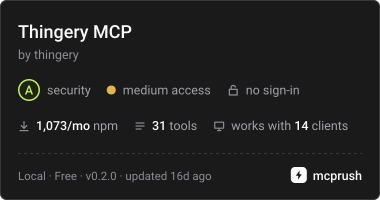
io.github.thingery/thingery
Open item database and MCP server for AI agents to list, find, and trade second-hand goods.
Documentation

Thingery
Thingery is the open item database and MCP server for AI agents to list, find, and trade second-hand goods.
Say "sell this" to your AI assistant — it identifies the item, writes the listing, prices it, and publishes it. Say "find me a used camera under €300" — it searches every listing and proposes the best one. Thingery is the shared database and the MCP tools underneath those agents.
- Free for everyone. No take rate, no platform lock-in.
- Open source (Apache-2.0). Self-host the whole thing, or use the flagship instance.
- Agent-native: every capability is an MCP tool; any LLM can drive it.
- Self-hostable: Postgres + pgvector + Node 20.
Chinese-market name: 物坊 (Wùfāng).
Documentation: docs.thingery.dev — connecting clients, guides, the full MCP tool reference, and self-hosting.
Quickstart
The hosted MCP server is https://thingery.dev/mcp. Add it to your client and sign in when
it asks:
# Claude Code
claude mcp add --transport http thingery https://thingery.dev/mcp
Claude, ChatGPT, Cursor, VS Code and other clients: see Connect a client. Searching needs no account — try it with curl:
curl -s https://thingery.dev/mcp \
  -H 'content-type: application/json' \
  -H 'accept: application/json, text/event-stream' \
  -d '{"jsonrpc":"2.0","id":1,"method":"tools/call",
       "params":{"name":"search_items","arguments":{"q":"Air Max"}}}'
To run your own server on your own Postgres (npm install thingery, or from source), see
Self-hosting.
Directory profile
Connector directories whose policies exclude money-transfer tools (e.g. the Claude Connectors Directory) should use the directory profile instead of the canonical URL:
https://thingery.dev/mcp?profile=directory
It registers only the 15 item-discovery, listing-authoring, and wanted-board tools;
ordering and payments complete on thingery.dev. The canonical /mcp (no parameter)
keeps the full tool surface for self-hosters, registries, and direct clients.
Authentication is identical on both URLs — included seller tools keep the OAuth
onboarding challenge, public reads stay anonymous. Unknown profile values are
rejected with 400 rather than silently falling back to the full tool set.
Documentation
| Topic | Where |
|---|---|
| First search and first listing | Quickstart |
| Claude, ChatGPT, Cursor, VS Code, stdio, plain HTTP | Connect a client |
| OAuth and API keys | Authentication |
| Selling, buying, orders, alerts, wanted board | Guides |
| Every MCP tool and its parameters | MCP tools |
| Self-hosting and environment variables | Self-hosting |
| Prices, conditions, the flexible item schema | Data conventions |
| The two-level category registry (departments, aliases, typed sizes) | Data conventions |
| Common errors | Troubleshooting |
The docs live in docs-site/ and publish with Mintlify. The tool reference is
generated from src/tools.ts (npm run docs:tools), and a test fails when it falls out of date.
Note for self-hosters: the categories table is managed — db/schema.sql owns its rows,
and running a migration converges the registry to the shipped definitions. See
Data conventions → Category registry.
Design records are in docs/adr/.
Agent skills: skills/sell-item (photos → priced listing) and
skills/find-item (intent → one best proposal → saved-search alerts).
Machine discovery: llms.txt · agents.json.
Roadmap
Order state machine— shipped in code; payments not live yet: orders with Stripe Connect payouts, carrier webhooks, disputes, and deadline sweeps (ADR 0003). thingery.dev runs orders off-platform only — no Stripe keys are configured in production — until legal/ToS sign-off flips payments on.- Seller skill upgrade — photo capture shipped: frictionless item-page capture, placeholder art, and photo-gated publishing (ADR 0005). Comparable-based pricing is deferred until listings are numerous enough to be real comparables.
- Buyer alerts — next up: "new match for your intent" event stream.
- Federation protocol — instance-to-instance sync so anyone can host a node of the Item Graph. Deferred.
- Agent-to-agent negotiation — bounded-mandate negotiation between buyer and seller agents. Deferred.
We'll revisit federation and negotiation when there's real traction: more than 10 new listings per week for 2 consecutive weeks, or concrete pull from self-host adopters.
Security
What's verified and what isn't: docs/security-note.md. To report a vulnerability privately, see SECURITY.md.
Contributing
Built by an agent team with a human architect — see AGENTS.md for the working
conventions. PRs welcome; CI (typecheck, build, tests) must pass. New here? Start with
docs/community.md — good first issues, dev setup in under 10 minutes,
and where to ask questions.
License
thingerynpm install thingerythingerynpm install thingery