
depquiet
io.github.samuelrojas-dev/depquiet
Plans the change that closes your dependency alerts, verified with uv or Poetry.
Documentation
depquiet





Tells you what to change to close your dependency alerts, verified with your project's own resolver, and which alerts never reach production.
Sometimes a Dependabot update gets stuck because one line in pyproject.toml still asks for
the old version. depquiet tries the update on a copy of your project with uv or Poetry and
shows you what needs to change. If fixing one package means rolling another one back,
you'll see that too.
pip install depquiet pip-audit
depquiet --fix-plan plan.diff --fix-plan-report plan.md   # the diff, and a pull request description
On a public uv SDK with 71 open Dependabot alerts and requires-python = ">=3.9"
(November 2026, run in a disposable VM):
- Keeping Python 3.9: 10 packages' fixes install, but only by moving the Python 3.9 copies of jupyterlab back to 2.3.2, notebook to 6.4.8 and nbconvert to 4.3.0. depquiet marks each one with ⚠ instead of calling the plan done.
- With
--raise-python-floor: 21 packages' fixes install together withrequires-python = ">=3.11.5". Not>=3.11: with that floor, uv splits the lock at 3.11.5 and Python 3.11.0–3.11.4 get beautifulsoup4 4.6.3, from 2018.
Its maintainers had reached the same "raise the floor and relock" change by hand, as had the maintainers of another uv project whose Dependabot pytest update had failed four times. depquiet verifies resolution only: whether your code works with the new versions is for your tests to say.
It also triages. depquiet reads your lockfile and dependency groups, drops the alerts that only your development tools install, and keeps everything else: an alert is only dismissed when the lockfile proves it.
On real projects
pip-audit on popular Python projects, at the commits that were their head on 2026-11-11,
audited again on 2026-11-15 with depquiet 0.47.0:
| Project | pip-audit alerts | Only reach dev tooling | Left to look at |
|---|---|---|---|
| saleor | 21 | 14 | 7 |
| zulip | 49 | 26 | 23 |
| mlflow | 21 | 14 | 7 |
| langflow | 80 | 13 | 67 |
| PostHog | 269 | 8 | 261 |
Every filtered alert has one reason: development-only paths in the lockfile, the only kind
of alert depquiet still filters. The same pip-audit report given to depquiet 0.39.0, which
first measured this table on 2026-11-11, gets the same verdict for every alert on all 18
projects measured: the counts grew because advisories were published in between, not
because depquiet changed. The 2026-11-11 dismissals were also checked by hand against a
separate walk of each uv.lock; most were virtualenv and filelock pulled in by
pre-commit. Details and the other projects: benchmarks.
Of the alerts left, many cannot be fixed by the upgrade the scanner names. Across 18 uv
projects on 2026-11-12, uv's resolver rejects the nearest fix for 502 of 991 kept alerts (51%), in 13 of
the 17 projects with alerts; in 81% of the blocked upgrades, the project's own pin is what
is in the way. See --check-fixes.
For uv and Poetry projects depquiet goes one step further: --fix-plan
computes the requirement changes that let the fixes install together and verifies them
with the project's own resolver, and the GitHub Action's
fix-pr opens one pull request
with them. That includes the case where Dependabot reports that it "cannot update" the
dependency "to a non-vulnerable version": a parent package that must move before a
vulnerable dependency can.
On npm, npm audit --omit=dev already does this: depquiet matches it row for row on the
projects measured, and adds which direct dependency brings each kept alert in.
Quick start
pip install depquiet pip-audit
cd your-project
depquiet                                 # npm, pnpm and Python in one run
depquiet explain GHSA-3jp2-3mrg-2vxc     # why this alert got its verdict
depquiet --check-fixes                   # uv projects: can each fix actually be installed?
# GitHub Actions
- uses: samuelrojas-dev/depquiet@v0
Reads uv.lock, poetry.lock, requirement files, package-lock.json, pnpm-lock.yaml and
yarn.lock, or the output of uv audit, Trivy, Grype, Snyk, Dependabot and SARIF tools.
Runs locally, no account, MIT.
What it is not
depquiet's triage works at the level of packages, not functions. It cannot tell you that an
imported package's vulnerable function is never called; Snyk, Endor Labs and, for Go,
govulncheck go further there. So does GitHub: since October 2026, Dependabot's
reachability analysis
(public preview, JavaScript and TypeScript, GitHub Enterprise Cloud) looks for a call path
to the vulnerable function. Where you have it, it is the deeper verdict for those projects.
None of these plan the fix: which requirement, Python floor or lock change closes the alert,
verified with the resolver. If your project is on uv, uv audit --no-dev gives you the
plain dev/production split natively; depquiet adds every group judged by name, the
dependency path, EPSS and mixed npm/Python repositories.
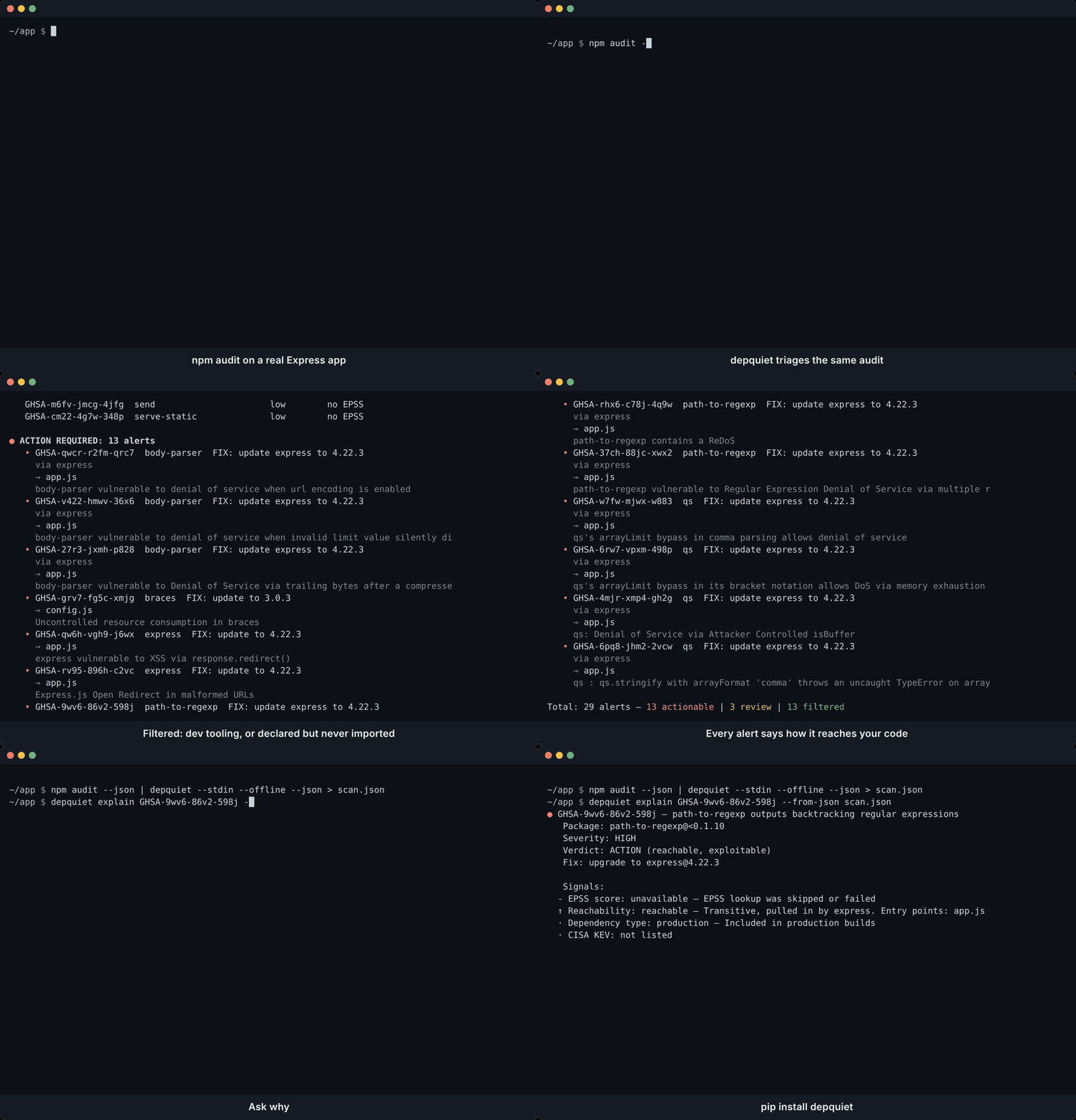
The recording is a small Express app, where most of the noise is packages the app never imports. Every line is real command output (how it's made).
The problem
Dependency scanners report every advisory that matches a version range, whether or not your application can reach the vulnerable code:
- npm audit is "broken by design" (Dan Abramov)
- Dependabot is a "noise machine": Filippo Valsorda recommends turning it off in favor of reachability-aware tools like
govulncheck
The result is alert fatigue: teams either spend hours triaging noise or start ignoring alerts, real ones included.
How it works
depquiet filters one kind of alert on its own: what only development pulls in. Everything else it keeps, and it sorts and explains it:
| Signal | Effect |
|---|---|
| Dev dependencies | Filtered when every known dependency path is for development, with no production parent. For npm, also when every locked copy inside the advisory's range is one the lockfile marks as development-only (unless package.json declares that top-level copy for production: then the lockfile is stale) |
| Reachability | Never filters. A production package that nothing imports, directly or through the production dependencies that bring it in, is shown for review: another library may load it at runtime |
| Test-only use | Never filters. A production package imported only from test files is shown for review: an ORM loads its database driver from a dialect name (Sequelize, TypeORM, Knex and pg), Next.js loads sharp, PyJWT loads cryptography, and no import names them |
| EPSS scoring | Off by default: EPSS only orders the report (known exploited first, then highest EPSS). With --epss-threshold, alerts scoring below it are filtered. EPSS is keyed by CVE id: pip-audit and uv audit give it as an alias, and for npm audit, which reports only GitHub advisory ids, depquiet looks the CVE up on OSV.dev (cached) |
| Community templates | A built-in template never dismisses on its own: when it matches, its note is added to the review. Custom templates without conditions, .depquiet-ignore and policy rules are your explicit dismissals |
Bundled frontends: like npm audit --omit=dev, depquiet treats devDependencies as
development-only. If your bundler (Vite, webpack, esbuild) ships a package listed there in
your production JavaScript, move it to dependencies or add it to always_flag, or depquiet
will filter its alerts.
See benchmarks for measured results on a real project.
Conservative by design
depquiet would rather let a false positive through than dismiss a real vulnerability:
- Transitive dependencies are judged by their parents. Your code never imports
path-to-regexp; Express does. depquiet reads your manifests and lockfiles to find the direct dependencies that pull a package in, and keeps the alert if your code imports any of them. See Direct vs. transitive. - Unknown means not filtered. If no manifest or lockfile says whether a package is direct or transitive, or a file fails to parse, the alert is not filtered on reachability.
- Declared but never imported is not proof. Frameworks load packages your code never
imports: Django its database driver,
transformerstheaccelerateyou declared, Sequelize thepgnamed by its dialect. No lockfile records those edges, so a production dependency your code does not import goes to review instead of being dismissed, and so does everything it brings in:uvicornstarted from the command line is never imported, yeth11parses every request. - Production paths override development labels. A package listed in
devDependenciesis still kept when a production dependency also pulls it in. A transitive package imported by the application is kept even when its declared parent is unused. - Import-level, not call-graph. Reachability means "the package enters your app", not
"the vulnerable function is called". It removes packages your app never loads; it does not
prove an imported package's vulnerable function is unused. For Go,
govulncheckdoes symbol-level analysis and is the better tool.
Supported inputs
depquiet reads the dependency alerts of these scanners, natively or through SARIF:
| Scanner | Format | Input method |
|---|---|---|
| None (standalone) | Lockfiles | depquiet (auto-detects lockfiles, queries OSV.dev) |
| npm audit | JSON | npm audit --json | depquiet --stdin |
| pnpm audit | JSON | depquiet in a project with pnpm-lock.yaml, or pnpm audit --json | depquiet --stdin |
| pip-audit | JSON | pip-audit --format json | depquiet --stdin |
| uv audit (uv 0.13+) | JSON | depquiet --scanner uv, or uv audit --frozen --output-format json | depquiet --stdin |
| Trivy | JSON or SARIF | trivy fs --format json . | depquiet --stdin |
| Grype | JSON | grype dir:. -o json | depquiet --stdin |
| Snyk | JSON | snyk test --json | depquiet --stdin |
| Dependabot | API JSON | gh api /repos/O/R/dependabot/alerts --paginate | depquiet --stdin |
| Any SARIF dependency scanner | SARIF v2.1.0 | <scanner> --sarif | depquiet --stdin |
| CycloneDX SBOM | JSON | depquiet --from-sbom vendor.cdx.json |
| SPDX SBOM | JSON | depquiet --from-sbom vendor.spdx.json |
The SARIF parser reads dependency findings from Trivy, Grype, Snyk and other tools that emit SARIF v2.1.0: CVE, package name, severity (CVSS or level-based) and fix version come from the standard SARIF fields and common scanner-specific properties. A result that names no package is a code finding (CodeQL, Semgrep and other static analysis): depquiet does not triage it and says how many it left out, and a SARIF file with only code findings is reported as not scanned, never as clean.
npm component evidence
For npm audit input, JSON keeps the legacy version value and identifies it as
version_kind: advisory_range. Separate components record exact lockfile
versions, node locations, source hashes and stable instance IDs. Each candidate
has its own range_match; npm's package-level node list is not a per-advisory
affected-version list. Unknown or partial resolution remains explicit.
CycloneDX, SPDX and OpenVEX use those component identities instead of presenting an advisory range as a component version. No lockfile resolution claims an observed installation or product impact. See npm component evidence for the JSON contract, matching limits and export behavior. Explicitly scoped reports support instance baselines and diffs; unscoped legacy reports retain their existing identities.
Standalone scanning with OSV.dev
When no scanner output is piped in and no native package manager is detected, depquiet falls back to lockfile scanning via OSV.dev — Google's open, free vulnerability database. Just run depquiet in any project with a lockfile:
| Lockfile | Ecosystem |
|---|---|
package-lock.json / yarn.lock (Yarn 1 and Berry) / pnpm-lock.yaml (v5 to v9) | npm |
uv.lock / poetry.lock / requirements.txt / Pipfile.lock | PyPI |
go.sum | Go |
Cargo.lock | crates.io |
pubspec.lock | Pub (Dart/Flutter) |
Gemfile.lock | RubyGems |
composer.lock | Packagist (PHP) |
packages.lock.json | NuGet (C#) |
Multiple lockfiles in the same project are merged and deduplicated. OSV.dev queries
are batched in groups of up to 1000 packages, then each distinct advisory is fetched
for its severity, CVE aliases and fixed versions. All pages and advisory lookups must
succeed before the scan is considered complete, and a lockfile that cannot be parsed stops
the scan instead of being left out of it. Use --offline to skip OSV.dev queries.
A project with pnpm-lock.yaml is audited with pnpm audit when pnpm is installed, and
through OSV.dev otherwise. A Yarn project is scanned from yarn.lock through OSV.dev:
npm audit cannot read that file.
A Python project without uv.lock or poetry.lock is audited from its requirement files:
requirements*.txt at the root and requirements/*.txt. Files named for tooling
(requirements-dev.txt, requirements/test.txt, docs.txt) are left out unless they are
the only ones. A compiled file (pip-compile, uv pip compile, hashes) is audited as
written, with no resolver run. Any other requirements.txt is resolved by pip, so the
packages it pulls in are audited too; when pip cannot resolve it, the exact versions it
lists are audited instead, and the report names the lines that have no exact version.
Every file left out, and every partial audit, is stated in the report.
SBOM generation (CycloneDX + SPDX)
depquiet generates both major SBOM standards required by US Executive Order 14028:
# CycloneDX 1.5 (OWASP standard)
depquiet --sbom sbom.json              # CycloneDX JSON
depquiet --sbom sbom.xml               # CycloneDX XML (auto-detected)
depquiet --sbom out.cdx --sbom-format xml

# SPDX 2.3 (ISO/IEC 5962:2021)
depquiet --sbom sbom.spdx.json         # SPDX JSON (auto-detected)
depquiet --sbom out.spdx --sbom-format spdx
Both formats include full component inventory with Package URLs (purl), vulnerability references for known CVEs, depquiet triage verdicts, and tool creator metadata. CycloneDX additionally maps verdicts to analysis states; SPDX uses SECURITY external references with NVD links.
SBOM output works alongside all other flags — combine --sbom with --sarif to generate both in one pass.
SBOM import — triage from third-party SBOMs
depquiet can consume CycloneDX and SPDX SBOMs as input, enabling triage on third-party SBOMs from vendors, container registries, or build systems — without needing the original lockfile:
# Explicit file input
depquiet --from-sbom vendor-sbom.cdx.json    # CycloneDX 1.4/1.5 JSON
depquiet --from-sbom vendor-sbom.spdx.json   # SPDX 2.3 JSON

# Piped via stdin (auto-detected)
cat container-sbom.json | depquiet --stdin
Two-mode operation:
- Vulnerability mode — if the SBOM contains vulnerability data (CycloneDX
vulnerabilitiesarray or SPDX SECURITY external refs), those are extracted and triaged directly - Package mode — if no vulnerability data is present, the package inventory is extracted and queried against OSV.dev for known advisories
An inventory-only SBOM cannot be scanned with --offline. Missing packages or a failed
OSV.dev lookup produce "nothing scanned" and exit code 2, rather than a clean report.
All standard depquiet flags work with SBOM input: --epss-threshold, --kev, --sbom (re-export), --sarif, --html, etc.
Workspace and dynamic-import coverage
Declared npm workspaces and uv [tool.uv.workspace] members have independent
dependency graphs, command metadata and source scopes. Deep declared members are
discovered beyond the legacy depth limit. A package used by a production member
cannot be classified as dev-only solely from the root's declaration.
Scan JSON and saved explain output retain per-workspace usage, dependency roots
and coverage. Unreadable/malformed manifests, links that could hide a manifest or
recognized loaders with nonliteral targets block automatic absence-based
decisions. Several locked versions of one package, duplicate member names and
names shared between ecosystems do not: their edges are merged, which can only
add dependency paths. Positive imports remain visible alongside uncertainty.
A project with both JavaScript (npm or pnpm) and Python dependencies is scanned for both in
one run. Each ecosystem is audited by its own scanner and triaged against its own dependency
graph, and every finding records which one reported it ("package_manager" in the JSON).
If one scanner fails, the other's findings are still reported and the note says which
ecosystem was not scanned. --scanner npm, --scanner pnpm or --scanner pip limits a run
to one.
The analysis is bounded: initial workspace support covers npm and uv declarations, and finding-to-workspace associations use conservative dependency names rather than claiming an installed instance or verified call path. Other layouts retain legacy discovery. See workspace and dynamic-import coverage for patterns, limits, aggregation and compatibility.
Reachability analysis in depth
Import detection works differently for each language:
Python — AST extraction via ast.parse() observes ordinary imports and
recognized importlib.import_module / __import__ calls, including direct aliases.
Literal targets provide positive import evidence; nonliteral, conditional or
rebound loader bindings retain uncertainty. Comments and strings are not executed
as loader calls. Files that fail AST parsing retain the existing regex fallback;
this does not establish complete parse or dynamic-loader coverage.
JavaScript / TypeScript — Comment-stripping pipeline + pattern matching on actual import syntax. Handles all major import styles:
- ESM:
import X from 'pkg',import {a, b} from 'pkg',import 'pkg'(side-effect) - CommonJS:
require('pkg') - Dynamic:
import('pkg') - Re-exports:
export {a} from 'pkg',export * from 'pkg' - Scoped packages:
@scope/nameresolved correctly - Strips
//and/* */comments so commented-out imports don't cause false positives - Zero runtime dependencies — no external JS parser needed
A bounded lexer additionally observes require(...), import(...) and
module.require(...) calls. Nonliteral targets retain explicit uncertainty with
file/line evidence. This is lexical analysis, not a full JavaScript/TypeScript
parser or arbitrary loader/dataflow resolution.
Go — Import statement parsing with comment stripping. Handles:
- Single imports:
import "pkg" - Grouped imports:
import ( "pkg1" ; "pkg2" ) - Aliased, dot, and blank imports:
import m "pkg",import _ "pkg" - Module path resolution:
github.com/user/repo/sub→github.com/user/repo golang.org/x/*packages resolved correctly- Skips
vendor/directory
Rust — Import statement parsing with comment stripping. Handles:
use crate_name::...anduse crate_name;extern crate crate_name;andextern crate crate_name as alias;- Nested use:
use crate_name::{a, b}; - Hyphen-to-underscore normalization:
my-cratein Cargo.toml →my_cratein source - Skips Rust-internal path roots:
self,super,crate,std,core,alloc - Skips
target/directory
Java / Kotlin — Import statement parsing with comment stripping. Handles:
- Standard imports:
import com.example.Foo; - Static imports:
import static org.junit.Assert.assertEquals; - Wildcard imports:
import com.example.*; - Kotlin imports (no semicolons):
import com.example.Foo - Maven coordinate splitting:
groupId:artifactId→ matches againstgroupIdprefix - Package-path heuristic: walks dot-separated segments until an uppercase class name or
* - Skips
build/directory
C# — Using directive parsing with comment stripping. Handles:
- Standard usings:
using Newtonsoft.Json; - Static usings:
using static System.Math; - Alias usings:
using Json = Newtonsoft.Json.JsonConvert; - Global usings:
global using System.Linq; - NuGet namespace matching: package name matches the root namespace prefix
- Skips
build/directory
PHP — Use statement parsing with comment stripping. Handles:
- Standard use:
use Monolog\Logger; - Function use:
use function GuzzleHttp\Promise\all; - Const use:
use const GuzzleHttp\Promise\FULFILLED; - Composer vendor/package convention: first two namespace segments lowercased and joined with
/ - Case-insensitive matching (PHP namespaces are case-insensitive)
- Strips
//,#, and/* */comments - Skips
vendor/directory
Ruby — Require statement parsing with comment stripping. Handles:
require 'gem_name'(single and double quotes)require 'gem_name/sub'→ extracts top-levelgem_namerequire_relativeskipped (project-internal files)- Hyphenated gem convention:
aws-sdk-s3matches bothrequire 'aws-sdk-s3'andrequire 'aws/sdk/s3' - Strips
#and=begin/=endcomments - Skips
vendor/directory
Swift — Import statement parsing with comment stripping. Handles:
- Standard imports:
import ModuleName - Kind imports:
import struct Module.Type,import class Module.Class,import func Module.func - Testable imports:
@testable import ModuleName - SwiftPM package-to-module mapping: hyphens become underscores (
swift-argument-parser→swift_argument_parser) - Top-level module name extraction from dotted imports
- Skips
.build/directory
Dart / Flutter — Import statement parsing with comment stripping. Handles:
- Package imports:
import 'package:name/file.dart'; - Subpath imports:
import 'package:name/src/sub.dart';→ extractsname dart:SDK imports skipped (SDK-internal)- Relative imports skipped (project-internal)
- Hyphen-to-underscore normalization for scanners that report with hyphens
- Skips
.dart_tool/directory
All ten analyzers map aliased package names (e.g., my-package → my_package for Python, @scope/name/sub → @scope/name for JS, github.com/user/repo/sub → github.com/user/repo for Go, my-crate → my_crate for Rust, com.fasterxml.jackson.core:jackson-databind → com.fasterxml.jackson.core for Java, Newtonsoft.Json.Linq → Newtonsoft.Json for C#, Monolog\Logger\Handler → monolog/logger for PHP, aws-sdk-s3 → matches require 'aws/sdk/s3' for Ruby, swift-argument-parser → swift_argument_parser for Swift, flutter-bloc → flutter_bloc for Dart) and check all source files in the project, skipping node_modules, .git, __pycache__, dist, build, .build, .dart_tool, vendor, target, and other vendored directories.
Direct vs. transitive dependencies
The import check only answers "does my code import this package?", which is the right question for direct dependencies and the wrong one for transitive ones. Since v0.28.0 depquiet builds a dependency graph from the project before filtering:
| Ecosystem | Direct dependencies from | Dependency paths from |
|---|---|---|
| npm | package.json, package-lock.json, pnpm-lock.yaml importers | package-lock.json (v1-v3), yarn.lock (v1, berry), pnpm-lock.yaml (v5-v9) |
| Python | uv.lock, pyproject.toml (PEP 621, PEP 735, Poetry), Pipfile, requirements.in, hand-written requirements.txt | uv.lock, poetry.lock, pip-compile # via comments |
| Rust | Cargo.lock workspace crates | Cargo.lock |
| Ruby | Gemfile.lock | Gemfile.lock |
| PHP | composer.json | composer.lock |
| .NET | packages.lock.json | packages.lock.json |
| Dart | pubspec.lock | — |
| Go | go.mod (// indirect) | — |
| Java (Maven) | pom.xml | — |
Rules, in order:
- Direct dependency that nothing uses (no import, never run as a command, not loaded by a used dependency): kept for review, not filtered. Frameworks load packages your code never imports, and no lockfile records that.
- Transitive dependency: kept for review when none of the direct dependencies that pull it in are used, ACTION when one is. With no known path (Go, Dart, Maven) it is never filtered.
- Development only: filtered when every known path to the package is a development one, with no production parent. This is the only rule that filters.
A direct dependency is used when any of these holds:
- a source file imports it. Python distribution names are mapped to module names
(
PyYAML→yaml,llama-index-core→llama_index). When the package is installed, in the project's virtualenv or in the environment depquiet runs in, its recorded modules are used. Otherwise depquiet tries a table of known mismatches and every name the distribution name allows, including a bare prefix:django-auth-ldapis matched byimport django. Such a match keeps the alert, and the report says it rests on a name guess instead of listing those files as usage. Run depquiet where the dependencies are installed to get exact answers; - the project runs one of its executables:
pm2 startin apackage.jsonscript, aProcfileentry, or a Dockerfile command; - it is named in the project's code, scripts or config (
INSTALLED_APPS = ["allauth"],postgresql+psycopg2://,celery flowerin a service script). Docs, manifests and lockfiles don't count; - a used dependency loads it itself (FastAPI loads
python-multipart, SQLAlchemy loads database drivers).
A wrong match only moves an alert from REVIEW to ACTION; it never hides one.
Unknown dependency type: never filtered. This includes a requirements.txt where every line is pinned
with == and there are no # via comments, since that is indistinguishable from
pip freeze output.
depquiet explain <CVE> shows the dependency type and the packages that pull it in, and
--json output includes dependency_type and introduced_by for every alert.
Install
pip install depquiet
Usage
# Auto-detect lockfiles and scan (no scanner needed — uses OSV.dev)
depquiet

# Scan a specific directory
depquiet --path ./my-app

# Pipe in existing audit output
npm audit --json | depquiet --stdin
pip-audit --format json | depquiet --stdin
trivy fs --format json . | depquiet --stdin
grype dir:. -o json | depquiet --stdin
snyk test --json | depquiet --stdin
gh api /repos/OWNER/REPO/dependabot/alerts --paginate | depquiet --stdin

# SARIF input from a dependency scanner
trivy fs --format sarif . | depquiet --stdin
grype dir:. -o sarif | depquiet --stdin

# Fully offline (skip EPSS API)
depquiet --offline

# A repo with both package-lock.json and uv.lock: both are scanned by default.
# To scan only one:
depquiet --scanner pip

# SARIF output for GitHub Code Scanning
depquiet --sarif results.sarif

# SBOM (EO 14028 compliance)
depquiet --sbom sbom.json                     # CycloneDX 1.5 JSON
depquiet --sbom sbom.xml --sbom-format xml    # CycloneDX 1.5 XML
depquiet --sbom sbom.spdx.json               # SPDX 2.3 JSON

# JSON output for scripting
depquiet --json

# Also filter alerts with EPSS below 5% (off by default)
depquiet --epss-threshold 0.05

# Use a custom config file
depquiet --config ./ci-config.yaml

# Auto-fix ACTION items that have a known fix version
depquiet --fix

# See what --fix would do without changing anything
depquiet --fix --dry-run

# License compliance scan
depquiet --license

# Use a suppression file (auto-detected from project root)
depquiet   # reads .depquiet-ignore if present

# Explicit ignore file
depquiet --ignore ./custom-ignore.yaml

# Write GitHub-flavored Markdown summary (for CI)
depquiet --summary report.md

# Self-contained HTML report (share via email/Slack/artifact)
depquiet --html report.html

# Configurable CI gate — fail only on critical findings
depquiet --fail-on critical

# Fail on high and above (skip moderate/low)
depquiet --fail-on high

# Never fail on findings (informational mode)
depquiet --fail-on none
Can the fix be installed? (--check-fixes)
"Update to 1.45.1" is only advice until the rest of your pins allow it. For a project with a
uv.lock, --check-fixes asks uv's own resolver, with uv lock --dry-run --upgrade-package,
whether each alert still shown can be fixed, and prints what blocks it if not. Nothing is
written. On saleor, both alerts that survive triage turn out to be blocked:
$ uv audit --frozen --output-format json | depquiet --stdin --check-fixes

🔴 ACTION REQUIRED: 2 alerts
   • GHSA-3jp2-3mrg-2vxc  oauthlib  FIX: update to 4.0.1
     ✗ fix check: blocked: `oauthlib` was filtered by `exclude-newer-package` to only include
       packages uploaded before 2026-09-28T06:02:00Z. The requested version, v4.0.1, was
       published at 2026-10-31T09:52:56.206Z. ...
   • GHSA-xcq7-p3pf-p88h  opentelemetry-api  FIX: update to 1.45.1
     ✗ fix check: blocked: Because opentelemetry-semantic-conventions==0.58b0 depends on
       opentelemetry-api==1.37.0 and your project depends on opentelemetry-api==1.45.1, ...
The first is saleor's own supply-chain cooldown; the second needs
opentelemetry-semantic-conventions upgraded in the same step. A fix that resolves prints
✓ fix check: resolves (uv lock --upgrade-package pkg==version). Each check is one
resolution against the package index, so it needs uv and network access; the JSON report
has a fix_check object per alert.
Measured on 18 uv projects (2026-11-12, at their head; script, raw output and every
resolver message in benchmarks/fixcheck_study). Each kept
alert was checked against its own nearest fix; each package also against its highest fix,
the one upgrade that clears all of its alerts:
| Kept alerts | Packages | |
|---|---|---|
| With a fix version | 991 | 175 |
| Fix resolves | 489 | 103 |
| Fix blocked | 502 (51%) | 72 (41%) |
What blocks the 72 package upgrades, read from uv's messages:
- 45: the project's own pin on that same package (
posthog requires aiohttp==3.13.5). - 13: another package's pin. depquiet retried each with that package upgraded in the same
step; none resolved, because in all 13 the project pins that package too (
posthog requires lxml==6.0.2, which holdslxml-html-clean). - 9: a Python version newer than the oldest the project supports; 2: the project's own
exclude-newercooldown; 3: not told apart from uv's message.
So 58 of the 72 (81%) come down to a pin in the project's own pyproject.toml, directly or
one step away. None failed for network or build reasons. Blocked does not mean unfixable:
it means the scanner's "update to X" is not enough, and the pin to widen is the answer.
For each block, --check-fixes says what to do next: the requirement of yours to widen, or
the blocking package and the pin that holds it, or the Python floor or cooldown. When
upgrading the blocking package in the same step resolves, it prints the command
(uv lock --upgrade-package a==1.2 --upgrade-package b).
The study ran in a disposable VM, for the reason below.
uv lock can run code: when a package (your project included) computes its metadata with a
setup.py or another build hook, uv executes it to find its dependencies. --check-fixes
does nothing uv lock would not do in the same checkout, but run it only on code you
trust, and not in CI jobs that check out pull requests from outside contributors.
One verified change for all the fixes (--fix-plan)
--check-fixes says, per package, whether the fix installs and what blocks it. --fix-plan
answers the next question: what do I change so the fixes install, together?
depquiet --fix-plan plan.diff     # or --fix-plan alone to print the diff
git apply plan.diff
uv lock --upgrade-package ...     # the command it prints
For a uv project it:
- widens each requirement of yours that blocks a fix, just enough (
==2.31.0→==2.33.0,<3.7→<4; other clauses, extras and markers stay as written); - when another package holds a fix back and you pin that package, lets uv pick a version of it that allows the fix, and pins that version in your style;
- applies everything to a temporary copy of the project and runs
uv lock --dry-runwith all the upgrades at once. If they don't fit together, it keeps each fix that still resolves with the ones already kept and reports the rest with uv's reason.
Nothing in the project is changed. What is verified is resolution only: whether your code
works with the new versions, a major version change above all, is for your tests to say.
Like --check-fixes, it runs uv lock, so use it on trusted code.
Real run on a small project pinning requests==2.31.0 and botocore==1.29.0 (which caps
urllib3 below 2):
🔧 Fix plan
   ✓ requests 2.31.0 → 2.33.0: widen your requirement
   ✓ urllib3 1.26.20 → 2.8.0: also move botocore → 1.44.2, which holds it back  (major version change)

   Verified with uv's resolver: all fixes resolve together.
   Then run: uv lock --upgrade-package requests==2.33.0 --upgrade-package urllib3==2.8.0 --upgrade-package botocore==1.44.2
-    "requests==2.31.0",
-    "botocore==1.29.0",
+    "requests==2.33.0",
+    "botocore==1.44.2",
After git apply and that command, pip-audit reports no known vulnerabilities in the
project's dependencies.
The plan also names everything else the verified lock moves, because a reviewer sees it in the lockfile diff: a parent that has to move with a fix without any requirement change, and packages that nothing requires any more. On a project locked at oaklib 0.7.4, which caps setuptools below 82:
🔧 Fix plan
   ✓ setuptools 81.0.0 → 83.0.0: upgrade  (major version change)

   It also changes uv.lock:
     · oaklib 0.7.4 → 0.7.5
     · appdirs 1.4.4 (removed: nothing requires it any more)
     · eutils 0.6.1 (removed: nothing requires it any more)
     ...
When only the lockfile moves, there is no diff to write, and depquiet says so.
Fixes that need a newer Python (--raise-python-floor)
A project that still declares requires-python = ">=3.9" cannot take a fix that supports
only 3.10 and up, even if it runs on 3.12: uv has to find versions for every Python the
project claims. Dependabot then fails on that update again and again. depquiet raises the
floor to what the fixes need on the temporary copy, asks uv again, and says what that
unblocks. Dropping a Python version is your decision (harmless for an application, a
breaking change for the users of a published library), so the edit goes into the plan only
with --raise-python-floor. Real run with uv 0.11 on a small project with
requires-python = ">=3.9", pytest locked twice (8.4.2 for 3.9, 9.2.0 for 3.10+) and an
alert fixed in pytest 9.0.0:
🔧 Fix plan
   ✓ tornado 6.4.1 → 6.5: upgrade
   ✗ pytest → 9.2.0: needs a newer Python: see Python floor below

   Python floor:
     Raising requires-python to >=3.10 would let 1 more fix install (pytest; 1 alert), verified with uv's resolver.
     It drops Python 3.9: fine for an application, a breaking change for users of a published library.
     Add --raise-python-floor to put that change in the plan.
With --raise-python-floor, the diff changes requires-python = ">=3.9" to ">=3.10"
(upper bounds such as <4 are kept; ~= and ==3.9.* are left for you to rewrite), and
--apply leaves pytest 9.2.0 as the only copy in uv.lock. The target is 9.2.0, not the
fix's 9.0.0, because the lock already had 9.2.0 for newer Pythons: the plan does not move
it back down. Workspace members whose own floor is lower are raised too. uv projects only
for now; on Poetry the python constraint is left as it is. The Action's input is
fix-pr-raise-python-floor.
Fixing filtered alerts too (--fix-filtered)
The plan covers the alerts depquiet shows. A filtered alert (pytest in a dev group, say)
needs no action by depquiet's reading, but Dependabot keeps it open until the package moves.
--fix-filtered (Action: fix-pr-include-filtered) checks and plans those fixes as well,
so one pull request can close them. That is the usual case for the Python floor above:
pytest and other test tools are often what a project's >=3.9 holds back.
Poetry projects
--fix-plan, --apply and fix-pr work on Poetry projects too (a poetry.lock and no
uv.lock), verified with Poetry's own resolver, for both [tool.poetry.dependencies] and
[project] requirements. Real run with Poetry 2.5.1 on the same case, requests = "2.31.0"
and botocore = "1.29.0":
🔧 Fix plan
   ✓ requests 2.31.0 → 2.33.0: widen your requirement
   ✓ urllib3 1.26.20 → 2.8.0: also move botocore → 1.44.3, which holds it back  (major version change)

   Verified with Poetry's resolver: all fixes resolve together.
   Then run: poetry update --lock requests urllib3 botocore
 [tool.poetry.dependencies]
 python = "^3.11"
-requests = "2.31.0"
-botocore = "1.29.0"
+requests = "2.33.0"
+botocore = "1.44.3"
10 alerts before, 0 after. What differs from uv:
poetry update --lock urllib3does not fail when botocore holds urllib3 back: it resolves and leaves urllib3 where it was. depquiet reads the holders frompoetry.lock, lets Poetry move them, and checks the new lock.- Poetry has no "upgrade to exactly this version":
poetry updatemoves a package to the newest version your constraints allow, so a range such as^2.31can land above the fix. An exact pin stays exact, at the fix version. The plan shows where each package ends. --check-fixeson its own is for uv projects. For Poetry the plan is the check.- Constraints with
||and git or path dependencies are not rewritten: that fix is listed as left out, with the reason. - No
exclude-newerhandling: that is a uv setting.
One pull request with every fix that installs (fix-pr)
--fix-plan --apply applies the verified plan to the project: it edits the requirements
and runs uv lock. If uv lock fails, every file is put back as it was. The Action's
fix-pr input does that on a schedule and opens one pull request with the result, so
the work left for you is to read it and let your tests run:
name: depquiet fixes
on:
  schedule:
    - cron: "17 6 * * 1"   # Mondays
  workflow_dispatch:
permissions:
  contents: write
  pull-requests: write
jobs:
  fix:
    runs-on: ubuntu-latest
    steps:
      - uses: actions/checkout@v4
      - uses: samuelrojas-dev/depquiet@v0
        with:
          fix-pr: "true"
          fail-on-action: "false"
          # fix-pr-token: ${{ secrets.DEPQUIET_PR_TOKEN }}
Real run on a project with requests==2.31.0 and botocore==1.29.0, where botocore holds
urllib3 below 1.27: 10 alerts before, 0 after, and this description on the pull request.
The project and both pull requests are public:
depquiet-fixpr-test, with
the uv pull request and
the Poetry one.
| Package | From | To | Advisories | How |
|---|---|---|---|---|
requests | 2.31.0 | 2.33.0 | PYSEC-2026-1873, PYSEC-2026-1872, PYSEC-2026-2275 | widens the project's own requirement |
urllib3 | 1.26.20 | 2.8.0 (major version change) | PYSEC-2026-1999, PYSEC-2026-1998, … | also moves botocore → 1.44.3, which held it back |
That second row is the case other tools leave open today. Dependabot cannot raise a parent to fix a vulnerable transitive dependency in Python projects (dependabot-core#16337, open as of November 2026): Dependabot reports that it cannot update the dependency to a non-vulnerable version (its error reference).
What to know before you turn it on:
- uv and Poetry projects, like
--fix-plan. The Action installs Poetry when it finds apoetry.lockand Poetry is not already on the runner. - The branch (
depquiet/security-fixes, orfix-pr-branch) is force-pushed on every run: it is always your branch plus one commit. Do not commit to it by hand. - The commit holds only
pyproject.toml,uv.toml,uv.lockandpoetry.lockchanges. - Your CI does not start on a pull request opened with the default
GITHUB_TOKEN: that is how GitHub works. Pass a personal access token or GitHub App token asfix-pr-tokento have your tests run on it. - The repository must allow it: Settings → Actions → General → "Allow GitHub Actions to create and approve pull requests".
- It never runs on
pull_requestevents:uv lockcan execute build hooks, and this step holds a token with write access. - depquiet checks that the versions resolve, not that your code works with them. Fixes it cannot verify are listed in the pull request as not included, with the reason.
- Set
fail-on-action: "false"in this workflow, as above: otherwise the job shows as failed even after it opens the pull request, because the alerts are still on your branch until you merge it. - Each run updates the open pull request. If you close it without merging, the next run
opens it again while the fixes remain available; unlike Dependabot, depquiet does not
remember a closed one. Add the advisories to
.depquiet-ignore, or turnfix-proff.
Fixes hidden by your cooldown (exclude-newer)
A cooldown (exclude-newer = "7 days", or a date) protects you from a malicious release
by hiding releases newer than the cut-off. It hides security fixes too: the scanner flags
the vulnerable version, uv lock says "No solution found", and the usual way out is to
switch the cooldown off. --fix-plan writes the narrowest exemption uv supports instead:
an exclude-newer-package cut-off for that package only, one second after the fix was
published. The package can move to the fix and no further, even with uv lock --upgrade,
and every other package keeps the cooldown. Existing exemptions are kept, and the entry
goes where you set exclude-newer (pyproject.toml or uv.toml).
Real run on a project with exclude-newer = "2025-06-01T00:00:00Z" and requests 2.32.3,
whose fix for CVE-2024-47081 (2.32.4) was published on 2025-06-09:
🔧 Fix plan
   ✓ requests 2.32.3 → 2.32.4: exempt it from your exclude-newer cooldown, only up to this release (published 2025-06-09)

   Verified with uv's resolver: all fixes resolve together.
   Then run: uv lock --upgrade-package requests==2.32.4
 [tool.uv]
 exclude-newer = "2025-06-01T00:00:00Z"
+exclude-newer-package = { requests = "2025-06-09T16:43:06Z" }
After git apply and that command, requests is at 2.32.4, uv lock --upgrade keeps it
there, and urllib3 stays under the project's cut-off. An exemption admits a release younger
than your cooldown, so the plan says so: check that it is the advisory's fix and comes from
the project's usual publisher before you merge.
Remove the entry once your cooldown catches up. A per-package date overrides the
cooldown for that package for good. With exclude-newer = "7 days", an entry left in place
holds the package at the fix release: in a real run, uv moved requests back from 2.34.2
to 2.32.4. With a rolling cooldown the plan prints the date after which to remove the
entry, and every depquiet scan warns about any exclude-newer-package date older than the
project's own cut-off, whoever wrote it:
⚠️ exclude-newer-package holds requests at releases before 2025-06-09T16:43:06Z, older than your cooldown's cut-off (2026-11-06T21:32:08Z): uv keeps requests on old releases. Remove the entry.
Auto-remediation (--fix)
depquiet --fix upgrades packages that have ACTION verdicts and a known fix version:
npm install <pkg>@<ver> for npm, and for a Python project with a uv.lock,
uv lock --upgrade-package <pkg>==<ver> (then uv sync installs it). When uv's resolver
refuses, the report says what blocks the fix, as --check-fixes
does. Other Python projects are not changed: pip install would only touch the environment
depquiet runs in and leave your requirement files as they are, so depquiet lists the
requirement to raise instead, and the alert still counts as open.
$ depquiet --fix

depquiet scan — npm (847 packages)
...

✅ Fixed 2 vulnerabilities:
   CVE-2024-4068  braces 3.0.2 → 3.0.3
   CVE-2024-33883  ejs 3.1.9 → 3.1.10

⚠️  1 ACTION items have no fix available:
   CVE-2024-21538  semver 7.5.4
Use --dry-run to preview changes without touching node_modules or site-packages:
$ depquiet --fix --dry-run

[dry-run] ✅ Fixed 2 vulnerabilities:
   CVE-2024-4068  braces 3.0.2 → 3.0.3   Would run: npm install braces@3.0.3
   CVE-2024-33883  ejs 3.1.9 → 3.1.10    Would run: npm install ejs@3.1.10
Exit codes with --fix: returns 0 when every ACTION item is resolved; returns 1 when any remain unfixed (no fix version, or the upgrade command failed).
License compliance (--license)
depquiet --license scans every installed dependency for license risk — copyleft contamination, unknown licenses, and restrictive terms that could block enterprise adoption or open-source distribution.
$ depquiet --license

depquiet license scan — npm (847 packages)

LOW (permissive):  812 packages
   MIT, Apache-2.0, BSD-2-Clause, ISC, ...

MEDIUM (weak copyleft):  4 packages
   LGPL-2.1   libfoo 3.2.1
   MPL-2.0    bar-utils 1.0.0
   ...

🔴 HIGH (copyleft):  2 packages
   GPL-3.0    gpl-thing 1.0.0
   GPL-2.0    another-gpl 2.1.0

🔴 CRITICAL (network copyleft / non-OSS):  1 package
   AGPL-3.0   agpl-server 0.5.0

⚠️  UNKNOWN:  1 package
   ???        mystery-pkg 1.2.3

License scan: FAIL — 4 packages need review
Risk levels:
| Level | Licenses | Meaning |
|---|---|---|
| LOW | MIT, BSD, Apache-2.0, ISC, Unlicense, ... | Permissive — safe for any use |
| MEDIUM | LGPL-2.1, LGPL-3.0, MPL-2.0, EPL-2.0 | Weak copyleft — check linking requirements |
| HIGH | GPL-2.0, GPL-3.0 | Strong copyleft — derivative works must be GPL |
| CRITICAL | AGPL-3.0, SSPL-1.0, BUSL-1.1 | Network copyleft or non-OSS — high legal risk |
| UNKNOWN | Unrecognized or missing | Needs manual review |
SPDX expressions are handled automatically: MIT OR GPL-3.0 picks the most permissive (MIT → LOW), MIT AND GPL-3.0 picks the most restrictive (GPL-3.0 → HIGH). Common non-SPDX strings like "Apache License 2.0" and "GPLv3" are normalized to their SPDX IDs.
Exit codes with --license: returns 0 when all dependencies are LOW or MEDIUM; returns 1 when any HIGH, CRITICAL, or UNKNOWN licenses are found.
Combine with JSON output for CI integration:
depquiet --license --json
With --json, the command emits one scan document. License results are included in its
license field; the vulnerability summary and results fields keep their existing shape.
Python packages and their licenses. The packages are the project's locked ones
(uv.lock, poetry.lock, pdm.lock or fully pinned requirement files), never the
environment depquiet runs in. Each license is read from the project's own virtualenv
(.venv, venv, env: METADATA files only, nothing is executed) when it holds that exact
version, else from PyPI for that version. With --offline, or when PyPI gives no license,
the package is UNKNOWN and the check fails: an unread license is not a permissive one.
Without a lockfile or pinned requirements, the report says the Python dependencies were
not checked.
Suppression file (.depquiet-ignore)
Teams need a way to acknowledge accepted risk without disabling the tool. The .depquiet-ignore file provides per-CVE and per-package suppressions with accountability:
ignores:
  # Suppress a specific CVE (any package)
  - cve: CVE-2024-1234
    reason: "Mitigated by WAF rule WR-123"
    expires: 2025-06-01
    author: alice

  # Suppress a CVE only for a specific package
  - cve: CVE-2024-5678
    package: lodash
    reason: "Only used in tests, no production exposure"

  # Suppress all CVEs for a package (migration planned)
  - package: deprecated-pkg
    reason: "Migration to replacement-pkg planned for Q2"
    expires: 2025-07-01
Place .depquiet-ignore in the project root (auto-detected) or pass --ignore path/to/file.yaml.
Match priority: CVE+package > CVE-only > package-only. Only ACTION and REVIEW items are suppressed — already-filtered items are left as-is.
Expiry dates: When an entry's expires date passes, it stops suppressing and depquiet prints a warning. This prevents suppressions from rotting forever — teams must re-evaluate periodically.
Audit trail: The reason field (recommended) explains why the risk was accepted. The author field records who made the decision.
Scan comparison (depquiet diff)
Compare two saved depquiet reports to see new or absent finding contexts and
verdict changes. Reports with the same explicit project_id automatically use
instance contexts: npm candidates match on advisory, exact version, node location,
lockfile path and advisory range/status. A newly added version or location remains
visible even when the advisory was already present. Partial or unknown evidence
stays explicit. Other scanners retain literal reported-version contexts.
When both reports lack a project ID, matching retains the legacy exact advisory,
package and reported-version string. A scanner range stays a range; the diff does
not infer an installed version or advisory aliases. Use --project-id team/service
to bind missing scopes explicitly, --instances to require instance mode, or
--legacy-identities for an explicit compatibility comparison. Declared project
IDs must agree in every mode; a CLI option cannot override a conflicting ID.
The historical fixed field means a finding context is absent from the head
report. It does not establish remediation or product non-affectedness. A version
replacement can therefore appear as one absent context and one new context.
Compare the same declared project/input scope when interpreting these changes.
# Compare a base branch scan against a PR branch scan
depquiet diff base-scan.json pr-scan.json

# Machine-readable output
depquiet diff base-scan.json pr-scan.json --json

# Fail CI only when new ACTION items appear
depquiet diff base-scan.json pr-scan.json --fail-on-new

# Require scoped instance comparison (both reports must be complete)
depquiet diff base-scan.json pr-scan.json --instances --project-id team/service --fail-on-new
An explicit incomplete scan (scanned: false), malformed report, incompatible scope
or duplicate finding identity is rejected with exit code 2 and a diagnostic
on stderr, without a successful diff or overwriting an existing summary. Other
operational errors also return 2. Exit 1 is used for new ACTION findings
with --fail-on-new; a missing input file retains its legacy exit code 1.
Legacy comparisons accept structurally valid older reports without scanned,
but their completion cannot be verified from that missing flag. Instance mode
requires scanned: true; older npm-project reports without version_kind require
a rescan or explicit legacy comparison. See identity and migration details.
Typical CI workflow:
- name: Scan base
  run: git stash && depquiet --json > /tmp/base.json && git stash pop

- name: Scan head
  run: depquiet --json > /tmp/head.json

- name: Diff
  run: depquiet diff /tmp/base.json /tmp/head.json --fail-on-new
Output shows new, fixed, and changed findings with severity, EPSS scores, and verdict transitions:
🆕 2 new | ✅ 1 fixed | 🔄 1 changed | — 12 unchanged

── New findings ──────────────────────────────────────
  [HIGH] CVE-2024-0001 in lodash@4.17.20 — Prototype Pollution → ACTION (EPSS: 42.0%)
GitHub PR comments
Post scan diff results directly on pull requests as rich Markdown comments — severity badges, EPSS scores, fix versions, and verdict changes at a glance.
# Markdown output for piping to gh pr comment
depquiet diff base.json head.json --markdown

# Write markdown to a file (e.g. for $GITHUB_STEP_SUMMARY)
depquiet diff base.json head.json --summary diff-report.md
GitHub Action — automatic PR comments with the diff-base and pr-comment inputs:
- uses: samuelrojas-dev/depquiet@v0
  with:
    diff-base: base-scan.json    # path to a base branch scan
    pr-comment: true             # post/update a PR comment with the diff
The action auto-updates the comment on re-runs (deletes previous depquiet comments first), writes a diff summary to $GITHUB_STEP_SUMMARY, and exposes diff-new / diff-fixed outputs for downstream steps.
Config scaffolder (depquiet init)
Bootstrap a .depquiet.yaml for your project in seconds. init auto-detects the package manager, CI provider, and existing scanners, then generates a config with sensible defaults.
# Interactive — shows detection results, asks before writing
depquiet init

# Non-interactive — accept all defaults (great for scripts)
depquiet init --yes

# Overwrite an existing config
depquiet init --yes --force

# Write to a custom path
depquiet init -o configs/depquiet.yaml
Detection covers 11 package managers (npm, pip, Go, Cargo, Maven, Gradle, Gem, Composer, Pub, NuGet), 6 CI providers (GitHub Actions, GitLab CI, Jenkins, CircleCI, Bitbucket, Azure DevOps), and 6 scanner tools (Snyk, Trivy, Grype, OSV-Scanner, Dependabot, Renovate). GitHub Actions projects automatically get SARIF and summary outputs enabled.
Verdict explainer (depquiet explain)
Understand exactly why a CVE received its verdict. Every contributing signal — EPSS score, reachability, dependency type, community template, KEV status, ignore rules — is laid out step-by-step so developers and security teams can audit triage decisions.
# Explain a CVE from a previous scan (saved with --json)
depquiet explain GHSA-9wv6-86v2-598j --from-json scan.json

# Machine-readable output
depquiet explain GHSA-9wv6-86v2-598j --from-json scan.json --json

# Live scan and explain
depquiet explain GHSA-9wv6-86v2-598j --path ./my-project
Look an alert up by its own id or by any alias: depquiet explain CVE-2024-35195 finds
the alert pip-audit reports as PYSEC-2026-1873. KEV reads "not listed" only when the
scan checked KEV (--kev, --kev-file or the config); otherwise it reads "not checked".
Each signal shows its effect on the final verdict:
🔴 GHSA-9wv6-86v2-598j — path-to-regexp outputs backtracking regular expressions
   Package: path-to-regexp@<0.1.10
   Severity: HIGH
   Verdict: ACTION (no automatic filter matched; product impact unverified)
   Fix: upgrade to express@4.22.3

   Signals:
  - EPSS score: unavailable — EPSS lookup was skipped or failed
  ↑ Reachability: reachable — Transitive, pulled in by express. Entry points: app.js
  · Dependency type: production — Included in production builds
  · CISA KEV: not checked — The scan ran without --kev
(The real Express benchmark, scanned with --offline, so no EPSS.)
Scan statistics (depquiet stats)
Get aggregate metrics for security dashboards and management reports. Works from --json output or a live scan.
# Stats from a saved scan
depquiet stats --from-json scan.json

# Machine-readable JSON
depquiet stats --from-json scan.json --json

# Top 5 affected packages
depquiet stats --from-json scan.json --top 5
Output includes verdict breakdown, severity distribution, filter reason analysis, top affected packages, EPSS distribution, and fix availability:
depquiet scan statistics
========================================

Total vulnerabilities: 29
Total dependencies:   14
Filter rate:          27.6%

Verdicts:
  🔴 ACTION       13 ( 44.8%) █████████░░░░░░░░░░░
  🟡 REVIEW        8 ( 27.6%) ██████░░░░░░░░░░░░░░
  🟢 FILTERED      8 ( 27.6%) ██████░░░░░░░░░░░░░░

Filter reasons:
  dev dependency               8 ( 50.0%)
  unreachable                  8 ( 50.0%)
...
CISA KEV integration (--kev)
The CISA Known Exploited Vulnerabilities (KEV) catalog lists CVEs with confirmed active exploitation. Under BOD 22-01, federal agencies must remediate KEV-listed CVEs within strict deadlines — and any organization should treat them as top priority.
# Check scan results against the KEV catalog
depquiet --kev

# Air-gapped environments: use a local copy of the catalog
depquiet --kev-file /path/to/known_exploited_vulnerabilities.json
How it works: KEV-listed CVEs are auto-escalated to ACTION regardless of other filters.
The match uses every identifier of the advisory: uv audit names advisories by GHSA id and
pip-audit by PYSEC or GHSA id, with the CVE as an alias, and KEV lists CVEs only.
npm audit gives no CVE at all, so depquiet looks it up on OSV.dev; an advisory whose CVE
cannot be found is reported as not checked, never as clean.
.depquiet-ignore entries and policy cves: match aliases the same way. A low-EPSS, devDependency, or unreachable vulnerability that's on the KEV catalog gets promoted to ACTION because active exploitation trumps all other signals.
The KEV feed is cached locally for 24 hours. On network failure, depquiet falls back to the expired cache. In --offline mode, only the cache is used.
JSON output includes KEV enrichment:
{
  "cve": "CVE-2021-44228",
  "verdict": "action",
  "kev": {
    "date_added": "2021-12-10",
    "due_date": "2021-12-24",
    "required_action": "Apply updates per vendor instructions.",
    "ransomware_use": true
  }
}
Combine with baseline and fail-on for maximum control:
# Accept known debt, but always flag KEV-listed CVEs
depquiet --baseline .depquiet-baseline.json --kev --fail-on high
HTML report (--html)
Generate a self-contained interactive HTML report — zero external dependencies, all CSS and JS inline, ready to share via email, Slack, or upload as a CI artifact.
depquiet --html report.html
The report includes a severity donut chart, collapsible sections (review auto-collapses when >5 findings, filtered always starts collapsed), dark mode support, and client-side text search. All data is embedded as JSON for future extensibility. XSS-safe: user-controlled values are escaped in both HTML and embedded JSON contexts.
PR annotations (--annotations)
Post vulnerability findings as inline annotations on PR diffs — like CodeQL or ESLint. Each ACTION or REVIEW finding becomes a GitHub Check Run annotation pointing at the package manifest or the file that imports the vulnerable package.
# Generate annotations JSON
depquiet --annotations annotations.json
In the GitHub Action, just add annotations: true:
- uses: samuelrojas-dev/depquiet@v1
  with:
    annotations: true
Annotations are automatically posted via the Check Runs API. Critical/high findings appear as errors, moderate as warnings, and low/info as notices. Each annotation includes the CVE, severity, EPSS score, fix version, and a link to the NVD advisory.
OpenVEX documents (--vex)
Generate OpenVEX documents that communicate the exploitability status of every vulnerability in your project. VEX (Vulnerability Exploitability eXchange) is the CISA-recommended format for telling downstream consumers which CVEs actually affect your software — and which don't.
# Generate an OpenVEX document
depquiet --vex vex.json
Priority and product impact are separate. The current engine observes dependency relationships and imports; it does not prove vulnerable-function execution or product-specific mitigations. Automatic exports preserve this uncertainty:
| Output | Automatic impact state | Priority and context |
|---|---|---|
| OpenVEX | under_investigation | status_notes contains priority, observations and limits |
| CycloneDX JSON/XML | in_triage | analysis.detail and per-component depquiet:triage properties |
| Scan JSON | assessment.status: under_investigation | Existing verdict, plus evidence and decision_trace |
A low EPSS, dev-only metadata, baseline, ignore or policy match never becomes an
automatic not_affected claim. The existing remediation priorities and exit-code
policy remain available. See the assessment contract.
The output is consumable by policy engines like Sigstore's policy-controller and OPA/Gatekeeper to gate container deployments.
# In the GitHub Action
- uses: samuelrojas-dev/depquiet@v1
  with:
    vex: depquiet-vex.json
Accepted baselines (--baseline)
Baseline v2 records explicit project-scoped acceptance of exact npm component contexts. Create a completed report, review its findings, then create the acceptance document with your reason and author metadata:
depquiet --project-id team/service --json > current-scan.json
# A completed scan may exit 1 when ACTION findings exist; inspect the saved report.
depquiet baseline create current-scan.json -o .depquiet-baseline-v2.json \
  --reason "Reviewed dependency debt; tracked for remediation" --author "Security team"
depquiet --project-id team/service --baseline .depquiet-baseline-v2.json --fail-on high
Creation accepts only fully resolved npm findings whose associated candidates all
match the advisory range. Partial, unknown and other scanner contexts appear in
unaccepted; a valid document may contain zero acceptances. A finding is demoted
from ACTION/REVIEW to FILTERED only when every current context is eligible and
accepted. New versions, locations or advisory range/status contexts remain visible.
The project ID must match, and the decision trace retains reason, author and path.
Acceptance changes priority; product impact remains under investigation.
Existing scan JSON files used directly with --baseline keep their broad
CVE:package legacy semantics, including across versions and node locations.
They are not migrated automatically. A declared project ID is enforced even for
this legacy format. For v2 migration, rescan with an explicit scope and review the
new acceptance document. See baseline format and compatibility.
Configurable CI gate (--fail-on)
By default, depquiet exits 1 whenever any ACTION item exists — just like Snyk's --severity-threshold. The --fail-on flag lets you control the minimum severity that fails the build:
--fail-on value | Fails on |
|---|---|
| (default) | Any ACTION item, regardless of severity |
critical | Critical only |
high | High + Critical |
moderate | Moderate + High + Critical |
low | Low + Moderate + High + Critical |
none | Never fails on findings (informational mode) |
This is useful for gradual adoption: start with --fail-on critical to block only the most dangerous vulnerabilities, then tighten the threshold as the team addresses lower-severity items.
# Block only critical and high vulnerabilities in CI
depquiet --fail-on high

# Informational mode — report everything, block nothing
depquiet --fail-on none --summary $GITHUB_STEP_SUMMARY
Use it from a coding agent (MCP)
Coding agents already try to work out by hand why a Dependabot fix won't install. depquiet ships an MCP server so they can ask it instead, and get an answer checked with the project's resolver rather than a guess.
pip install 'depquiet[mcp]' pip-audit
claude mcp add --transport stdio depquiet -- depquiet-mcp   # Claude Code
With uv, without installing anything: uvx --with 'mcp>=2.3,<3' --with pip-audit depquiet mcp (that is how
the MCP Registry entry runs it). depquiet mcp
and depquiet-mcp are the same server.
Other clients (Cursor, VS Code, Claude Desktop) take the usual entry:
{ "mcpServers": { "depquiet": { "command": "depquiet-mcp" } } }
Two tools, both read-only:
triage_alerts(path): the scan, per alert: verdict, why (dev-only, test-only, unreachable), fix version, and which Pythons a vulnerable locked copy serves.plan_fixes(path, raise_python_floor=false, include_filtered=false): the verified plan for uv and Poetry projects: the diff, the lock command, what else the lock moves, downgrades, and whether raisingrequires-pythonwould let more fixes in. When it would, the result says so, and the agent is told to ask the user before passingraise_python_floor=true.
Neither tool edits the project: the plan is checked on a temporary copy, and the agent applies the diff or runs the command when the user agrees. As with the CLI, resolving can build source distributions, so point it at projects you would resolve yourself.
CI Integration
Alerts without a severity. pip-audit and uv audit report no severity, so their
alerts show unknown ("severity": "unknown", "severity_known": false in --json;
unknown in SARIF properties, SBOM ratings, the summary and HTML report).
--fail-on high or critical counts those as meeting the threshold and says so on
stderr: a placeholder must never let a critical advisory through. For the same reason,
an ACTION alert without a severity is a SARIF error and a GitHub annotation failure. Use --fail-on none
to never fail, or a scanner that reports severity (npm audit, Grype, OSV.dev, an SBOM
with ratings) to gate on it.
Exit codes
0— No ACTION items at or above the--fail-onthreshold (safe to pass)1— ACTION items found at or above the threshold (fail the build)2— Nothing was scanned: no supported manifest or lockfile, a lockfile that needs OSV.dev while--offlineis set, or an input that cannot be read (--stdin,--from-sbom,--kev-file,--baseline). depquiet never reports an unscanned project as clean.
GitHub Actions (Marketplace)
- name: Triage vulnerabilities
  uses: samuelrojas-dev/depquiet@v0
  with:
    sarif: results.sarif
    policy: .depquiet-policy.yaml
    sbom: sbom.cdx.json
The action installs the depquiet version of the tag you reference, plus pip-audit for Python projects (install-pip-audit: false to skip; uv and Poetry when check-fixes or fix-pr need them, all three at pinned versions: pip-audit 2.10.1, uv 0.13.8, Poetry 2.5.1, unless the runner already has uv or Poetry), runs it, uploads SARIF to GitHub Code Scanning, uploads the SBOM as a build artifact, and fails the build if ACTION items are found. A repository with npm and Python dependencies is scanned for both; scanner: uv (or npm, pnpm, pip) limits it to one.
The action automatically writes a Job Summary to the PR checks page with severity badges, EPSS scores, fix versions, and a filtered breakdown.
For a uv project, check-fixes: true adds a "Can the fixes be installed?" table to the Job
Summary: each upgrade uv's resolver accepts, with the command, and each it rejects, with what
blocks it (your own pin, another package's pin, a Python floor or a cooldown). It installs uv
if the runner has none. It runs uv lock, which can execute build hooks, so enable it on
pushes and on pull requests from your own branches, not on pull_request_target or any job
that holds secrets while checking out outside contributions.
- uses: samuelrojas-dev/depquiet@v0
  with:
    check-fixes: true
Action inputs: path, scanner, epss-threshold, offline, sarif, templates, policy, sbom, sbom-format, from-sbom, ignore, license, baseline, kev, kev-file, html, annotations, vex, diff-base, pr-comment, check-fixes, fail-on-action, fail-on, python-version, install-pip-audit, fix-pr, fix-pr-branch, fix-pr-token.
Action outputs: total, action, review, filtered (alert counts), sarif-file and
sbom-file (paths, when generated), diff-new and diff-fixed (when diff-base is set),
fix-pr-url (when fix-pr opened or updated a pull request).
- uses: samuelrojas-dev/depquiet@v0
  id: depquiet
  with:
    fail-on-action: "false"
- env:
    ACTION_COUNT: ${{ steps.depquiet.outputs.action }}
  run: echo "$ACTION_COUNT alerts need action"
Note:
fail-on(severity-based) supersedesfail-on-action(boolean). Whenfail-onis set,fail-on-actionis ignored.
fail-on-action: false only permits vulnerability findings. Scanner failures still fail
the step. Diff summaries and PR comments use the saved scan, including when findings
cause the scanning step to fail; they do not run another scan.
GitHub Actions (manual)
- name: Triage vulnerabilities
  run: |
    pip install depquiet
    depquiet --sarif results.sarif

- name: Upload SARIF
  uses: github/codeql-action/upload-sarif@v3
  with:
    sarif_file: results.sarif
Community templates
depquiet ships with 20 built-in templates in nuclei-style YAML.
A built-in template matches only when depquiet can read the project source and finds no
import of the package, or of any direct dependency that brings it in. Since 0.43 a match no
longer dismisses the alert: that is exactly the case where another library may load the
package (requests loads certifi on every HTTPS call), so the template's note is added to
the review instead. Custom templates without conditions are explicit unconditional
dismissal rules, so add not-imported conditions when that is not your intention.
Earlier versions gave each template a technical justification ("mitigated by Express 4.x defaults", "timing attack") that depquiet never verified, and some were wrong. Since 0.40.5 the reason states only what was checked.
| Template | Package | CVE |
|---|---|---|
| lodash prototype pollution | lodash | CVE-2020-8203, CVE-2019-10744, CVE-2018-16487 |
| semver ReDoS | semver | CVE-2022-25883 |
| express open redirect | express | CVE-2024-29041 |
| axios SSRF | axios | CVE-2023-45857 |
| json5 prototype pollution | json5 | CVE-2022-46175 |
| webpack-dev-middleware path traversal | webpack-dev-middleware | CVE-2024-29180 |
| ip SSRF | ip | CVE-2023-42282 |
| requests proxy-auth leak | requests | CVE-2023-32681 |
| cryptography null dereference | cryptography | CVE-2024-0727 |
| minimist prototype pollution | minimist | CVE-2021-44906, CVE-2020-7598 |
| nth-check ReDoS | nth-check | CVE-2021-3803 |
| postcss ReDoS | postcss | CVE-2023-44270, CVE-2021-23382, CVE-2021-23368 |
| glob-parent ReDoS | glob-parent | CVE-2020-28469 |
| node-forge signature verification | node-forge | CVE-2022-24771, CVE-2022-24772, CVE-2022-24773 |
| shell-quote injection | shell-quote | CVE-2021-42740 |
| qs prototype pollution | qs | CVE-2022-24999 |
| word-wrap ReDoS | word-wrap | CVE-2023-26115 |
| tough-cookie prototype pollution | tough-cookie | CVE-2023-26136 |
| js-yaml code execution | js-yaml | CVE-2013-4660 |
| certifi root CA removal | certifi | CVE-2023-37920, CVE-2024-39689 |
id: qs-prototype-pollution
reason: "No import of qs, or of a direct dependency that brings it in, was found in the project source. ..."
author: "@depquiet"
cves:
  - CVE-2022-24999
package: qs
not-imported: ["qs"]
Contributing a template
- Create a YAML file in
templates/dismiss/ - Add the CVE, affected package, and dismiss conditions
- Open a PR — the community reviews and merges
A template's reason must state only what depquiet checks. Technical arguments about how a library is used belong in the PR discussion, with a source, not in the dismissal text.
Configuration
Create .depquiet.yaml in your project root (or pass --config path/to/config.yaml).
Every key is optional — add only what you need:
# Triage tuning
project_id: team/service     # stable explicit scope for instance baselines/diffs
epss_threshold: 0.05          # filter EPSS below this (default: off, EPSS only orders)
offline: false                # skip EPSS API (default: false)
always_flag:                  # packages that must never be filtered
  - lodash
  - express
template_dirs:                # extra template directories
  - ./my-templates

# CI gate
fail_on: high                 # severity threshold: critical | high | moderate | low | none

# Integrations
kev: true                     # check CISA KEV catalog
kev_file: data/kev.json       # local KEV catalog (air-gapped)
license: true                 # run license compliance analysis

# Input paths (relative to project root)
policy: .depquiet-policy.yaml
ignore: .depquiet-ignore
baseline: reports/baseline.json

# Output files (relative to project root)
sarif: reports/depquiet.sarif
html: reports/depquiet.html
summary: reports/summary.md
sbom: reports/sbom.cdx.json
sbom_format: json             # json | xml | spdx
vex: reports/vex.json
annotations: reports/annotations.json
CLI flags always override config values when explicitly passed. template_dirs from both sources are merged. This enables zero-flag CI — just run depquiet and the config drives everything.
Policy engine
Commit security policies alongside your code. Rules match on vulnerability attributes and override the default triage verdict — first matching rule wins.
Create .depquiet-policy.yaml in your project root (or pass --policy path/to/policy.yaml):
rules:
  # Always block critical CVEs, even if filters would dismiss them
  - id: block-critical
    action: action
    severity: critical

  # Dismiss low-EPSS noise in dev dependencies
  - id: dismiss-low-epss-dev
    action: filter
    is_dev: true
    epss_below: 0.01

  # Always flag these core packages
  - id: block-core-packages
    action: action
    packages: [express, lodash]

  # Specific CVE override
  - id: accept-cve-1234
    action: filter
    cves: [CVE-2024-1234]
Match conditions
All conditions on a rule must match (AND logic):
| Condition | Type | Description |
|---|---|---|
severity | string or list | critical, high, medium (or moderate), low, info |
packages | string or list | Package names to match |
epss_below | float | EPSS score below this threshold |
epss_above | float | EPSS score above this threshold |
is_dev | bool | Match dev dependencies only |
has_fix | bool | Match vulnerabilities with a known fix |
cves | string or list | Specific CVE IDs |
An alert whose scanner states no severity (pip-audit, uv audit, or "Severity": "UNKNOWN"
from Trivy or Grype) never matches a severity condition: depquiet does not guess one, so a
rule that dismisses moderate alerts cannot dismiss alerts of unknown severity.
A rule with an unknown key (severty:), an unknown severity or an EPSS bound that is not a
number between 0 and 1 is skipped with a warning: dropping just that condition would widen the
rule to every finding. A trailing # comment on a line is ignored.
Actions
| Action | Aliases | Effect |
|---|---|---|
action | block | Escalate to ACTION REQUIRED |
review | Mark for review | |
filter | filtered, dismiss, ignore | Filter out |
Benchmarks
Six real projects: five popular open-source apps pinned to a commit, plus a small Express
app pinned to 2022 versions. npm projects are audited with npm audit, Python projects with
pip-audit on every version in their uv.lock / poetry.lock. Every verdict is listed in
benchmarks/RESULTS.md.
| Project | Scanner | Alerts | Filtered by 0.27 | Filtered now | Filtered by 0.27, kept now |
|---|---|---|---|---|---|
| mealie-recipes/mealie | pip-audit | 229 | 200 | 31 | 170 |
| hagopj13/node-express-boilerplate | npm audit | 163 | 115 | 29 | 86 |
| gothinkster/node-express-realworld-example-app | npm audit | 95 | 59 | 41 | 18 |
| Express app, 2022 versions | npm audit | 29 | 26 | 8 | 18 |
| paperless-ngx/paperless-ngx | pip-audit | 17 | 17 | 0 | 17 |
| sahat/hackathon-starter | npm audit | 2 | 2 | 2 | 0 |
| Total | 535 | 419 (78%) | 111 (21%) | 309 |
0.27 dismissed 309 alerts without evidence. It counted any package the app didn't import
itself as unreachable, which is true of nearly every transitive package, and it compared
Python distribution names literally, so Django, PyYAML or llama-index-core never matched
import django, import yaml or import llama_index.
What depquiet filters now is packages that only development tooling pulls in (jest,
eslint, nx, nodemon, pre-commit, mkdocs). On the npm projects those are the alerts
npm audit --omit=dev also removes. The realworld app declares axios under dependencies
but imports it only from its end-to-end tests; until 0.43 its 33 axios and form-data alerts
were filtered as test-only. They are now kept for review, because depquiet cannot tell that
case from a database driver a library loads at runtime. On these projects nearly every
other production dependency is in use, so the useful output is less the filtering than the trace: each kept
alert names the direct dependency it comes through and where the app uses it.
The same comparison on five larger projects at their head on 2026-11-10 (Kong/insomnia
8891ce2, open-webui b0e6098, saleor ea4a69f, uptime-kuma fb8ef0f, wekan 77239ee;
188 npm alerts) gives the same picture: depquiet
filters the 85 alerts npm audit --omit=dev drops, row for row, and nothing else. On npm,
expect depquiet to match --omit=dev and explain the rest, not to beat it. Python is
different, because pip-audit has no equivalent switch. On 17 projects with a uv.lock,
at their head on 2026-11-11, pip-audit reported 1,004 alerts and depquiet filtered 72 as
development-only:
| Project | pip-audit alerts | Development-only, filtered |
|---|---|---|
| zulip | 43 | 26 |
| saleor | 16 | 14 |
| langflow | 70 | 11 |
| mlflow | 17 | 10 |
| PostHog | 255 | 8 |
| llama_index, open-webui, pydantic-ai | 188 | 3 |
| nine others (Chainlit, crewAI, litellm, ...) | 415 | 0 |
Each verdict was checked against a separate walk of the project's uv.lock, with the
dependency groups of every project read by hand to decide which are tooling: none of the 72
packages is reachable from a production dependency, an extra or a non-tooling group. The
same walk finds 21 more development-only alerts that depquiet keeps, most of them in
llama_index, whose integration packages each declare their own dependencies.
That hand reading matters. A dependency group is only a named list: zulip keeps everything
its servers run in a group called prod, and PostHog keeps optional features in groups
such as sentiment. depquiet treats a group as development-only when its name says so
(dev, test, docs, lint...) and as production otherwise; up to 0.33.1 it treated
every group as development-only and filtered all 43 zulip alerts, 17 of them wrongly.
A group listed in uv's tool.uv.default-groups (or every group, with "all") is
production whatever its name, except dev: uv sync --no-dev, the usual production
install, still installs the other default groups. For Poetry, depquiet assumes production installs
with poetry install --only main: --without dev would still install a non-optional docs
or test group, which depquiet then filters.
Nothing else was filtered: every one of these projects has a dynamic import somewhere, which keeps the unused-dependency filter off.
Remeasured on 2026-11-15 with depquiet 0.47.0, at the same commits, in a disposable VM
(remeasure.sh),
on the 18 projects of the fix-check study: one
pip-audit report per project, given to both 0.39.0 and 0.47.0. No verdict differs on any of
them. Since that study's run on 2026-11-12, alerts went from 1,127 to 1,228 as advisories
were published, and filtered alerts from 104 to 114, every one of them for development-only
paths:
| Project | pip-audit alerts | Development-only, filtered |
|---|---|---|
| flask | 34 | 32 |
| zulip | 49 | 26 |
| saleor | 21 | 14 |
| mlflow | 21 | 14 |
| langflow | 80 | 13 |
| PostHog | 269 | 8 |
| litellm | 57 | 4 |
| redash, open-webui, llama_index | 237 | 3 |
| eight others (Chainlit, crewAI, mitmproxy, ...) | 460 | 0 |
The 10 newly filtered alerts (mlflow 4, litellm 4, langflow 2) were not checked by hand like the 72 above.
If your project is on uv, uv 0.13 ships uv audit (still experimental), and
uv audit --no-dev excludes the development group natively. depquiet reads uv audit
output too: depquiet --scanner uv, or automatically when uv is installed and pip-audit is
not. What it adds on top is the rest of the triage: every group judged by its name rather
than only dev, the direct dependency that brings each alert in, EPSS, and npm or pnpm
dependencies in the same run.
Run them yourself: python -I benchmarks/run_benchmark.py. The first run clones the pinned
commits into benchmarks/.cache/; benchmarks/capture_real.py re-captures the audits. The
synthetic fixtures in the same report are parser regression tests, not evidence.
Compared to
| depquiet | Dependabot alerts + reachability (preview) | uv audit --no-dev | |
|---|---|---|---|
| Fixes | one plan for all fixes, with the requirement, Python floor and lock changes, verified together (uv, Poetry) | security update pull requests, one per package; fails when the fix does not resolve | no |
| When a fix is blocked | names the blocker and the change that lifts it, verified | names the conflicting dependency in the failed update's message | no |
| Warns when the fix moves other packages back | yes | not documented | no |
| Reachability | package level, 10 ecosystems | function level, JS/TS | no |
| Dev-only alerts | every group, by name and lockfile | a runtime/development scope on each alert | excluded (uv groups) |
| Where it runs | anywhere: CLI, any CI, any scanner's report | GitHub (Enterprise Cloud for the preview) | anywhere |
Read from each tool's documentation in November 2026; preview features change.
depquiet ingests reports from npm audit, pip-audit, Trivy, Grype, Dependabot, Snyk and SARIF-producing tools. It adds dependency/import context, configurable priorities and decision history, and can query OSV directly from lockfiles.
The alert-reduction figures above describe captured scans; they do not establish false-positive rates or superiority over another scanner. The new reference evaluator checks labelled cases, including missing findings and unsafe dismissals. Two explicitly synthetic contract examples exercise its mechanics:
python benchmarks/reference/run.py --output synthetic-scan.json
python benchmarks/evaluate.py --labels benchmarks/reference/synthetic.labels.json --scan synthetic-scan.json --snapshot benchmarks/reference/synthetic.snapshot.json --json
The separate upstream reference set contains
10 selected advisory contexts from four pinned npm/Python projects, with frozen
audits, source hashes and review evidence. CI checks that five retain and five
unknown cases remain visible. Labels are agent-reviewed; human review is pending.
A separate configuration extension
adds two identities from the same pinned RealWorld project, preserving the original
inputs. The combined deliberate sample has 12 contexts: six retain, six
unknown, no filter labels and no human adjudications. It does not measure safe
noise reduction.
The review workflow prepares pending records, binds
them to exact label/snapshot/case identities and reports caller-declared human,
external and agent coverage separately. Disagreements remain uncertain; a human
filter record cannot weaken a proposed retain or unknown. Optional coverage
gates require explicit records without treating metadata as authenticated review.
There are no real filter labels, so this set does not measure safe dismissal,
full-project coverage or real-world accuracy. Replay requires no upstream code
execution or package installation.
License
MIT
Contributing
depquiet is designed to grow through community templates. Every template you contribute adds context that helps developers decide on an alert faster.
See CONTRIBUTING.md for guidelines.
depquietpip install depquiet