
plainontology
io.github.cfuracao-academic/plainontology
Serves the plain text ontology of your databases, JSON Schemas and APIs to AI agents.
Documentation
PlainOntology





Write down the ontology your system already has, as one plain text file that people can edit and AI agents can read.
Try it: pip install plainontology, then plainonto init my.onto --from sqlite:my.db, or paste a schema in your browser (nothing is uploaded)
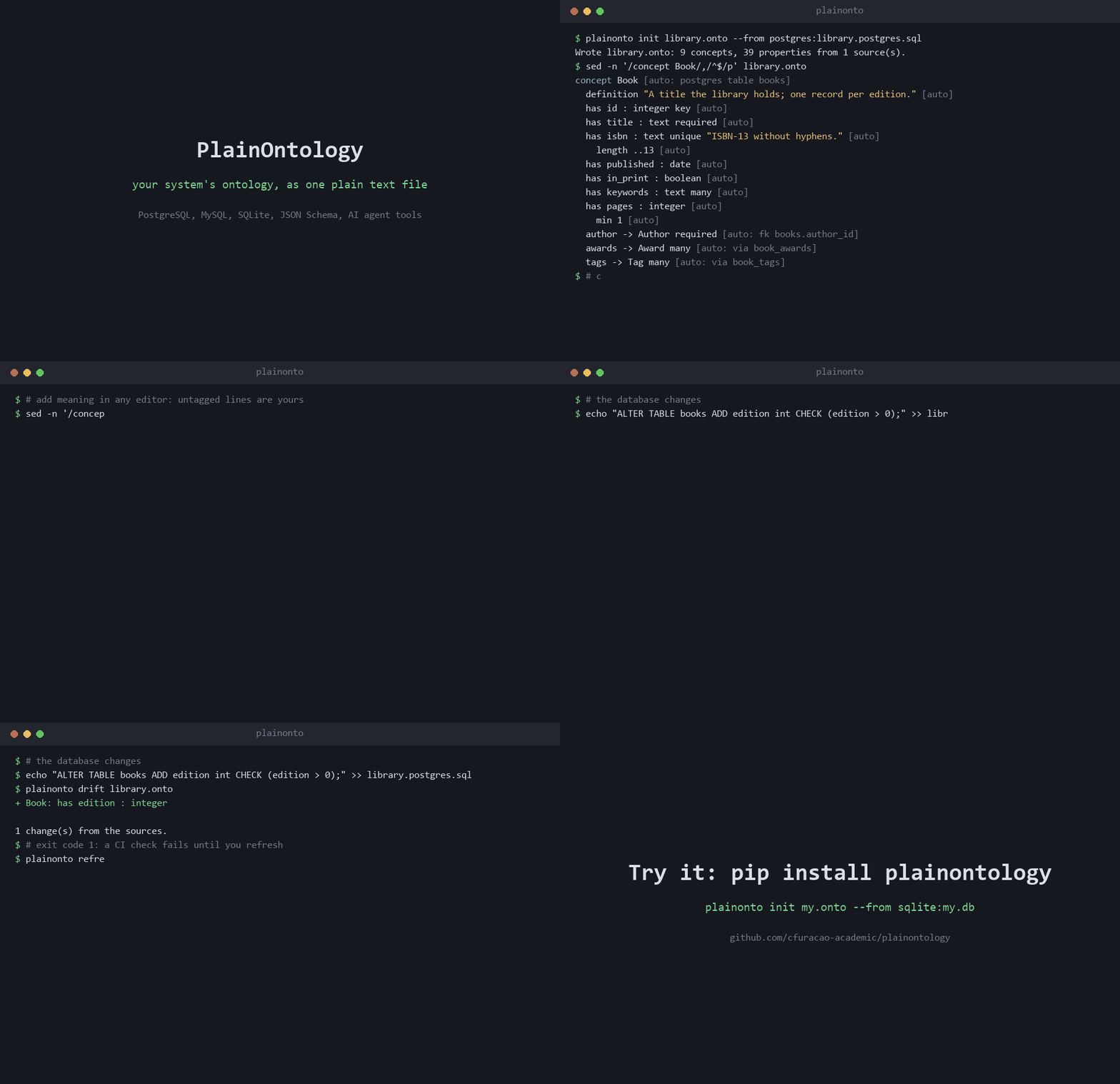
Every running system carries an implicit ontology: tables and foreign keys, JSON schemas, the tool definitions an LLM agent calls. Its meaning (what a "loan" is, that a "Title" is a "Book", that member holds personal data) usually lives in people's heads. PlainOntology extracts the structure into a readable text file, keeps your hand-written meaning next to it, and tells you when the system drifts away from it.
concept Book [auto: postgres table books]
  definition "A title the library holds; one record per edition." [auto]
  has id : integer key [auto]
  has title : text required [auto]
  has isbn : text unique "ISBN-13 without hyphens." [auto]
    length ..13 [auto]
    label "ISBN"
  has pages : integer [auto]
    min 1 [auto]
  author -> Author required [auto: fk books.author_id]
  tags -> Tag many [auto: via book_tags]
  label "Livre"@fr
  synonym "Title"
  same_as schema:Book
The definition and the description come from comments in the database, length ..13 from varchar(13), and min 1 from CHECK (pages > 0).
Lines tagged [auto] come from the sources and are refreshed. Every other line is yours and is never overwritten.
What it does
| Extract | PostgreSQL, MySQL and SQLite (live databases, dumps or migration scripts), JSON Schema (draft 7 and 2020-12, across files), OpenAPI 3.x and Swagger 2.0, dbt manifests, and AI agent tool definitions (Anthropic, OpenAI Chat and Responses, MCP tools/list) |
| Keep your edits | Refresh replaces [auto] lines only. If you rewrite an extracted line, your version wins and is reported |
| Follow renames | A renamed table or column keeps your lines; plainonto rename handles the cases it cannot guess, and --no-renames turns the guessing off |
| Report drift | plainonto drift exits 1 when the sources changed; a GitHub Action and pre-commit hooks put it in CI. It also warns when two sources define the same concept |
| Check | Duplicate lines, unknown targets, undeclared prefixes, misplaced rules, proposals waiting for review |
| Validate | Check JSON records (for example an agent's structured output) against a concept: types, enums, required fields, min, max, length, pattern, format |
| Multilingual | Labels, definitions and synonyms in any language (label "Livre"@fr) |
| Export | RDF Turtle (OWL structure, SKOS meaning), SHACL shapes for validating RDF data, and LinkML YAML |
| Serve to agents | An MCP server so agents look concepts up, validate their output, and propose new lines for a person to review |
The core has no dependencies beyond the Python standard library. Extras: mcp for the MCP server, postgres and mysql for those databases, openapi for YAML OpenAPI files, all for everything.
Documentation: tutorial, sources, CI, agents and the file format (also built as a site with mkdocs serve).
Quick start
pip install "plainontology[all]"     # or just [mcp], [postgres], [mysql], [openapi]

cd examples
plainonto init mine.onto --from sqlite:library.sql --from tools:agent-tools.json
# edit mine.onto: add definitions, synonyms, same_as mappings
plainonto refresh mine.onto       # re-extract; your lines stay
plainonto drift mine.onto         # report only; exit 1 on drift
plainonto check mine.onto
plainonto export mine.onto --to turtle -o library.ttl
plainonto export mine.onto --to shacl -o library.shapes.ttl
plainonto export mine.onto --to linkml -o library.yaml
plainonto validate mine.onto Loan record.json
plainonto rename mine.onto Member Patron   # after a table rename that refresh did not detect
The command is plainonto (short for plainontology; both work).
Sources are written KIND:LOCATION and stored in the file; file paths are relative to it:
| Kind | Location |
|---|---|
postgres | a schema dump (pg_dump --schema-only), or a live database: env:VARIABLE holding the URL |
mysql | a schema dump (mysqldump --no-data), or a live MySQL or MariaDB database: env:VARIABLE |
sqlite | a SQLite database, or a SQLite-compatible .sql file (loaded into memory) |
jsonschema | a JSON Schema file; $defs and nested objects become concepts. For Pydantic, dump Model.model_json_schema() first |
openapi | an OpenAPI 3.x or Swagger 2.0 file (JSON, or YAML with the openapi extra): schemas become concepts, operations become concepts with their parameters, body and returns |
dbt | a dbt manifest (target/manifest.json) or the project folder: models and sources become concepts; not_null, unique, accepted_values, relationships and accepted_range tests carry over; lineage and semantic-layer measures become notes |
tools | a JSON list of tool definitions, or an object with a tools list |
Databases. Dumps are read in their own dialect, and live databases through SQLAlchemy, read-only. Both give the same result (CI checks this against real PostgreSQL 16 and MySQL 8.4 servers):
| From the database | In the file |
|---|---|
| tables, views | concepts (views get a note); tables outside public keep their schema: archive.orders becomes ArchiveOrder |
| table and column comments | the concept's definition, the property's description |
| primary and foreign keys, unique constraints | key, relations, unique, unique (a, b) |
CHECK (x IN (...)), CHECK (x >= 0), CHECK (x ~ 'regex'), varchar(n) | an enum, min, pattern, length ..n; other checks become notes |
enums, domains, arrays, tinyint(1) | enum(...), the domain's type, its CHECKs and NOT NULL, many, boolean |
LIKE other, CREATE TABLE ... AS SELECT, INHERITS (parent) | the copied columns (and keys and checks with INCLUDING); the query's columns; is_a Parent |
| join tables | a many relation; a join table with extra columns also stays a concept |
| triggers | notes |
ALTER TABLE (add, drop, rename and change columns, rename tables) | applied in order, so a folder of migration scripts concatenated into one file works as a dump |
| partitions | fold into the parent table with a note; foreign keys declared on partitions carry up |
| anything the parser cannot read | reported as a ? warning, never dropped silently; a table is read column by column so one odd column cannot hide it |
Everything else in a dump (SET, data, functions) is skipped. For a live database:
export LIBRARY_DB="postgresql://reader@db.internal/library"   # password via ~/.pgpass, or in this variable
plainonto init library.onto --from postgres:env:LIBRARY_DB
A URL with a password is refused, because the source line is saved in the ontology file.
Use it in CI and git hooks
# .github/workflows/ontology.yml
on: [pull_request]
permissions: { contents: read, pull-requests: write }
jobs:
  drift:
    runs-on: ubuntu-latest
    steps:
      - uses: actions/checkout@v4
      - uses: cfuracao-academic/plainontology@v0.2.0
        with:
          file: ontology/library.onto
          install: plainontology[postgres]
          comment: "true"          # post the drift report on the pull request
# .pre-commit-config.yaml
repos:
  - repo: https://github.com/cfuracao-academic/plainontology
    rev: v0.2.0
    hooks:
      - id: plainonto-check
      - id: plainonto-drift   # runs on every commit, so a schema-only change is caught
plainonto drift and plainonto check with no file check every .onto file under the current folder. All inputs are in docs/ci.md. Editors: a VS Code extension highlights .onto files.
Tried on real schemas
CI extracts two public sample databases at pinned versions on every push:
| Schema | Result |
|---|---|
| Pagila (PostgreSQL) | 25 concepts from 71 tables and 8 views (one materialized): 55 monthly partitions fold into Payment, foreign keys declared on partitions carry up, a PostgreSQL 18 virtual column is read; no warnings, check --strict clean |
| Sakila (MySQL) | 23 concepts (16 tables, 7 views); no warnings, check --strict clean |
Each takes about 0.4 seconds.
Performance
1,000 tables (13,500 lines) extract or refresh in about 1.5 seconds; 5,000 tables in about 7; check and the exports take under a second. Time grows linearly. Details and the script in docs/performance.md.
Use it from an AI agent (MCP)
plainonto mcp path/to/library.onto                    # read-only tools
plainonto mcp path/to/library.onto --allow-proposals  # also lets agents propose lines
Claude Code:
claude mcp add plainontology -- plainonto mcp /absolute/path/to/library.onto
Claude Desktop or any MCP client (mcpServers in the client's config):
{
  "mcpServers": {
    "plainontology": { "command": "plainonto", "args": ["mcp", "/absolute/path/to/library.onto"] }
  }
}
| Tool | What it does |
|---|---|
list_concepts | every concept with its definition |
describe_concept | a concept's lines, inherited properties and who points to it |
search | find concepts by name, label, synonym, definition or property |
validate_record | check a JSON object against a concept before acting on it |
drift | compare the file with its sources now |
propose | only with --allow-proposals: add a line tagged [proposed]; a person accepts it by deleting the tag |
The file is re-read on every call, so edits show up at once. Agents can never change or delete an existing line.
Why a text file
- Diffable. Ontology changes go through pull requests like code.
- Two layers in one place. Structure (
has,->,is_a) and meaning (label,definition,synonym,same_as,note) sit together, so neither drifts from the other. - Interoperable. Export to OWL/SKOS and LinkML when you need the standard toolchains.
How it compares
| PlainOntology | LinkML | OWL editors (Protégé) | Data catalogues (DataHub, OpenMetadata) | |
|---|---|---|---|---|
| Direction | extracts from a running system | you write the schema, it generates | you write the ontology | ingests metadata |
| Format | one plain text file | YAML | RDF/OWL | database behind a server |
| Keeps hand edits across re-extraction | yes | n/a | n/a | partly |
| LLM tool schemas and MCP | yes | no | no | no |
| Setup | pip install | pip install | desktop app | servers |
PlainOntology does not replace these. It exports to LinkML and OWL so you can move to them when you need more.
Format
The full grammar and refresh rules are in SPEC.md. In short:
prefix : <https://example.org/library#>
source sqlite:library.sql

concept NAME [auto: where it came from]
  has PROPERTY : TYPE [FLAGS] ["description"]
    label "..."            (also synonym, note: about the property)
    min N                  (also max N, length LOW..HIGH, pattern "regex", format email)
  PROPERTY -> CONCEPT [FLAGS] ["description"]
  is_a CONCEPT
  unique (PROPERTY, PROPERTY)
  label "..."@fr           (also definition, synonym, note; language tag optional)
  same_as prefix:Term
Types: text integer decimal boolean date datetime binary json any enum(a|b). Flags: key required unique many. The empty prefix line sets the base IRI for exports.
Scope
PlainOntology reads schemas by parsing their syntax, not by asking a running database. It is tested on output from pg_dump, mysqldump and SQLite, on Django, Rails, Laravel, Prisma and Flyway migrations, and on public schemas such as Pagila and Sakila. Hand-written SQL in unusual forms, vendor extensions and edge cases may fall outside what it reads. When a statement or column cannot be read, the report says so with a ? warning rather than guessing. For the exact picture, point it at a live database or a fresh dump from your database tool.
Known limitations
-
To give an extracted concept a friendlier name, add a
label; the concept name follows the source. -
Concept names are made with English singular rules (
booksbecomesBook,peoplebecomesPerson). -
The MCP server searches by keyword, runs locally over stdio, and does not lock the file while an agent proposes a line.
-
JSON Schema references to web URLs are not fetched;
plainonto checkflags the missing concept. -
CHECK constraints more complex than a list, a comparison, a range or a regex are kept as notes, not enforced by
validate. -
Field names that are not valid property names (
first name,@id) becomefirst_nameand_id;validateaccepts either form in a record. -
Patterns are Python regular expressions.
validate, pyshacl and LinkML use them as they are; other SHACL engines (XPath regex) may not accept\b, look-arounds or(?i). -
Views are read for their columns and types; the meaning of the query itself is not.
Development
python -m venv .venv && .venv/bin/pip install -e ".[dev]"
pytest
See CONTRIBUTING.md and ROADMAP.md.
Citing
If you use PlainOntology in research, please cite it using CITATION.cff. The DOI 10.5281/zenodo.24562420 always points to the latest version; each release also has its own DOI on Zenodo.
Licence
MIT
plainontologypip install plainontology