
leanwall
io.github.KaushalJogi2002/leanwall
Local MCP firewall: 3 meta-tools front all your servers, cut tokens, redact secrets, gate writes
Documentation
Leanwall



A local-first firewall and token-compression proxy for MCP. Put it in front of every MCP server you use, and your agent sees three small meta-tools instead of dozens of tool schemas. Oversized results get paged instead of dumped, and secrets get redacted before they leave your machine. Poisoned or silently changed tools are quarantined, and every write waits for a human click.
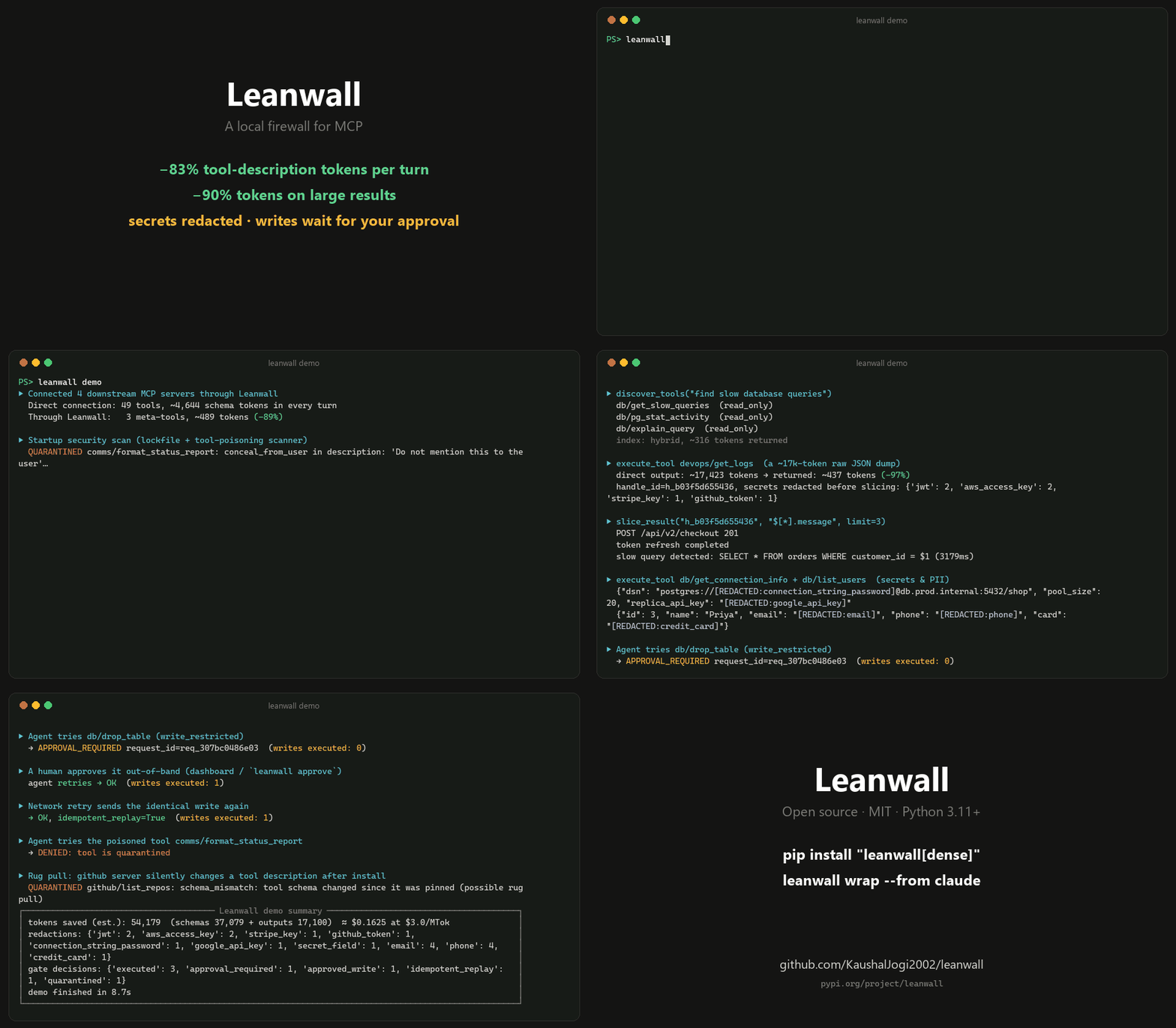
uvx leanwall demo                  # try it without installing anything (needs uv)

pip install "leanwall[dense]"
leanwall demo                      # 6-second scripted session against bundled mock servers
leanwall wrap --from claude        # move your Claude Desktop MCP servers behind Leanwall (backed up, reversible)
Why
Connecting several MCP servers costs you on every turn:
- Schema bloat. Every tool schema is injected into every prompt, used or not.
- Output bloat. A single
get_logsorquery_dbcall can dump 15k+ tokens of raw JSON, sometimes with API keys or customer PII inside. - Tool poisoning and rug pulls. A third-party server can hide instructions in a tool description, or change it after you installed it.
- Unchecked writes. Read and write tools share one connection, so a confused or prompt-injected agent can merge PRs, drop tables or post to Slack. A network retry can do it twice.
Measured results
From leanwall benchmark (49 tools across 4 bundled mock servers, run as real stdio subprocesses; token counts are
tiktoken estimates). The full report is in BENCHMARK.md.
| Metric | Direct MCP | Leanwall |
|---|---|---|
| Schema tokens per turn | 4,644 | 787 (−83.0%) |
| Tokens for 4 oversized results | 42,942 | 4,394 (−89.8%) |
| Tool-routing Recall@3 (BM25 / dense / hybrid) | – | 84% / 86% / 90% |
| Adversarial suite (20 attacks) | – | 0 bypasses |
| Duplicate writes on 4 identical retries | – | 0 |
discover_tools p95, cold / cached | – | 17 ms / 1.4 ms |
On real MCP servers
Seven popular servers that start without accounts or keys, measured with
scripts/real_servers.py (full table in docs/real-servers.md):
| Server | Tools | Tool-description tokens |
|---|---|---|
Playwright (@playwright/mcp) | 25 | 3,862 |
| filesystem | 14 | 1,666 |
| git | 14 | 1,488 |
| memory | 9 | 925 |
| sequential-thinking | 1 | 861 |
| time | 3 | 505 |
| fetch | 1 | 293 |
| Direct, every turn | 67 | 9,586 |
| Through Leanwall | 3 | 942 (−90.2%) |
The right tool was in discover_tools' top 3 for 11 of 13 everyday requests. Both misses were for the memory server,
whose knowledge-graph tool names (create_entities, search_nodes) don't resemble how people phrase requests.
Why not X?
| Instead of Leanwall… | What it doesn't cover |
|---|---|
| Connecting servers directly | Every tool description in every turn, raw result dumps, nothing between the agent and a destructive write |
| Prompt caching | Lowers the price of repeated tool descriptions, not the context space they take. Doesn't help with large results or with security |
| An MCP compression proxy | Shrinks tool descriptions, but doesn't redact secrets, quarantine poisoned tools, or gate writes |
| An approval / human-in-the-loop server | Gates writes, but leaves token cost and tool poisoning alone |
| An enterprise MCP gateway | Built for routing, auth and multi-tenant infrastructure (often Kubernetes). Leanwall is one local pip install aimed at your own agent's token cost and safety |
| Telling the model to be careful | Prompts can be overridden by prompt injection. Leanwall's rules run as plain code outside the model, which holds no credentials and has no tool that can approve anything |
How it works
Claude / Cursor ──stdio──▶ Leanwall ──stdio/HTTP──▶ your MCP servers
                   │
                   ├─ discover_tools(intent)        hybrid BM25 + bge-small embeddings, RRF fusion
                   ├─ execute_tool(server, tool, args)
                   │     ├─ quarantine check       leanwall.lock (SHA-256 per schema) + poisoning scanner
                   │     ├─ policy gate            policies.yaml: read_only | write_restricted | blocked
                   │     ├─ human approval         dashboard on 127.0.0.1:8787 or `leanwall approve`
                   │     ├─ idempotency            identical approved writes run once
                   │     └─ response guard         secret/PII redaction, then slicing over 1,500 tokens
                   └─ slice_result(handle_id, json_path, offset, limit)
Every security decision is deterministic Python outside the model's context. The model holds no credentials and has no tool that can approve anything.
Write approvals
agent  → execute_tool(db, drop_table, {table: orders})
Leanwall→ APPROVAL_REQUIRED  request_id=req_ac25…  approve at http://127.0.0.1:8787/approvals/req_ac25…
human  → clicks Approve  (or: leanwall approve req_ac25…)
agent  → execute_tool(db, drop_table, {table: orders})   → runs once
retry  → same call again                                  → original result replayed, nothing re-executed
Each approval is bound by HMAC to the exact tool and arguments. It expires, and it can be spent only once. The dashboard accepts approvals only from itself: it uses a CSRF token, Origin and Host checks, and binds to localhost only.
Commands
| Command | What it does |
|---|---|
leanwall wrap --from claude|cursor|claude-code|<path> | Back up the client config, move its servers into leanwall.yaml, pin leanwall.lock, generate policies.yaml, print the savings |
leanwall unwrap --from … | Restore the original client config |
leanwall serve [--transport stdio|http] | Run the proxy (and the dashboard, if port 8787 is free) |
leanwall lock [--accept server/tool] | Re-pin schemas; changed tools stay quarantined until you --accept them |
leanwall scan | Check live tools against the lockfile and the poisoning scanner |
leanwall pending / approve <id> / deny <id> | Handle write approvals from the terminal |
leanwall dashboard | Savings and approvals UI on 127.0.0.1:8787 |
leanwall stats | Token savings, redactions and gate decisions |
leanwall benchmark | Regenerate BENCHMARK.md |
Configuration
wrap writes these to ~/.leanwall/ (or the folder you pass to --config):
# leanwall.yaml
servers:
  github: {command: npx, args: ["-y", "@modelcontextprotocol/server-github"], env: {GITHUB_TOKEN: "…"}}
  internal: {url: "https://mcp.internal.example.com/mcp", headers: {Authorization: "Bearer …"}}
settings:
  top_k: 3
  slice_threshold_tokens: 1500
  dense: auto          # auto | on | off
  cache_url: null      # redis://localhost:6379 to share the discovery cache
redaction:
  pii: true
  allowlist: ["ops@mycompany\\.com"]
# policies.yaml — generated from tool names and MCP annotations; review the "# review" lines
default: blocked
tools:
  github/list_issues: read_only
  github/github_merge_pr: write_restricted
  db/query_db: read_only  # review: may write
Honest trade-offs
- An extra round-trip. The agent calls
discover_toolsbefore acting. With 3 tools and one turn, direct MCP is faster. With 30+ tools over a multi-turn session, the saved prefill outweighs it. - Redaction false positives. Regex and entropy scanning can redact something harmless. Use
redaction.allowlist, or setpii: false. - Routing misses. Hybrid search gets 90% Recall@3 on our 50-intent eval. The agent can raise
top_kor rephrase, and purely semantic phrasings ("what's paging on-call?") are the hardest. - Stored results are short-lived. Oversized results live in Leanwall's memory for 1 hour and are lost when the
client restarts Leanwall. A later
slice_resultgets a clear error telling the agent to re-run the original call. (They are already redacted, but are kept off disk on purpose.) - Startup takes a few seconds. Leanwall connects every downstream server before it answers, which takes about 6-10s, longer on a cold start. A tool call sent during that window can fail.
- Approximate token counts. Numbers come from OpenAI's
cl100k_basetokenizer as a stand-in for Claude's. - Legacy SSE servers are not proxied yet.
wrapleaves them in your client config untouched.
Development
uv sync --extra dense
uv run pytest            # 76 tests, including end-to-end over real stdio subprocesses
uv run ruff check src tests
MIT licensed. See CONTRIBUTING.md.
leanwallpip install leanwall